On 4th March 2025, Claude Malhuret (a French Senator) gave the clearest description possible of the impact of Donald Trump’s egregious politics on both the USA and the rest of the world:
“… Trump’s message is that being his ally serves no purpose, … because he will not defend you, … he will impose more tariffs on you than on his enemies, … and he will threaten to seize your territories, while supporting the dictators who invade you.“
picture by “ClarisseBuchot” Wikipedia, CC BY SA 4.0
Malhuret’s speech has been widely reported (like here at “The Atlantic“, for example). I applaud his courage in plainly saying what needed to be said.
“… The American shield is slipping away, Ukraine risks being abandoned, and Russia is being strengthened.
Washington has become the court of Nero – an incendiary emperor, submissive courtiers, and a buffoon on ketamine tasked with purging the civil service.”
Trump’s terrible gung-ho bullying approach to international politics has undermined the principles of acceptable behaviour for Nation States and likely destroyed NATO as a result. Under Trump, much of the World and most of Europe no longer sees the USA as a trustworthy ally:
“Let us remember that it only took one month, three weeks, and two days to bring down the Weimar Republic and its constitution. We were at war with a dictator; now we are fighting against a dictator supported by a traitor…”
“… the Trumpian vision coincides with Putin’s… a return to ‘spheres of influence’, where Great Powers dictate the fate of small Nations.”
It is very sad to see the USA, once the proud leader of the free world, now acting in the same sort of dictatorial manner as Putin’s Russia and other tyrannical States around the world. It remains to be seen whether Trump intends to transform USA society completely, running roughshod over their traditional Constitutional values, in order to seize total control of the country for himself and his cronies. In the meantime, the rest of the world and especially Europe, are now taking steps to protect themselves from the USA… something so previously unthinkable it feels surreal… and yet here we all are.
You can leave a comment on this post, or anything else on my website, with this form.
Even before Trump assumed office in ’25, it was obvious that his second term as US president was going to be rough for the rest of the democratic world. But I don’t think we expected such an abrupt about-face by the nation respected by most as the so-called ‘leaders of the free world’.
In just two months since Trump’s inauguration on 20th January, the USA has apparently transformed from being a strong partner who could be relied on to respect the norms of international law and help to ensure world peace through the projection of both soft and hard power, to becoming a hard-right isolationist state which apparently has more respect for Putin’s gangster Russia than the alliances it built over at least the seven decades since WW2.
‘Putin-Trump-2’ by Michiko K, Public Domain from flickr.com
However, I don’t think anyone expected so much arrogant belligerency from the new US leader. From consolidating as much power as possible in his office, to potentially setting back decades of progress on Climate Change, dismissing officials who might disagree with his programme and praising Putin, he is single-handedly taking the USA to a much harsher, isolationist position.
President Roosevelt is credited for the saying of “speak softly but carry a big stick”. And we all generally understand that a totalitarian, constant use of the stick does not usually help us to achieve our long-term goals. I don’t think Trump and Vance are mad, but their disregard for mutual security built with strong, respectful and supportive international relations leads me to suspect that they have been compromised by both Russia and international oligarchs (Russian and homegrown technogeeks).
The world has changed and Europe feels like the 1930’s again… … a calm before a storm…
So democratic nations in Europe need to change how they are collaborating…
… and the UK needs to rapidly change, to ensure this island nation is strong enough to stand alone again, if needed.
The USA no longer looks like a trustworthy partner for democratic nations around the world.
I suggest the following would be a good response from the UK:
Increase spending on Defence to 15% of GDP to fund the rapid growth of domestic Defence infrastructure (equivalent to 1939). Rapidly grow domestic arms factories, incl a focus on both high-tech missiles and low-tech drones.
Quickly develop UK domestic infrastructure to maintain Trident missiles.
Invest in an inventory of useful ex-USA munitions.
Increase the size and capabilities of both the Army and Air Force to levels recommended by the Chief of the Defence Staff.
… then…
Leave NATO.
End treaties enabling NATO/USA to station military personnel in the UK, with 30-day warning to remove all their personnel from UK territories, unless a new mutual defence treaty is agreed. Such new treaties to include the quid pro quo of reasonable bilateral trade agreements.
It is a pleasure to say that “Contain“ by Saul Tanpepper is a good book.
It is obviously independently/self-published (despite stating Brinestone Press as the publisher), and indeed a look at the final page shows that it was printed by Amazon in the UK. However, this book is at the upper end of independently published offerings:
* interesting cover art using an intriguing font,
* enticing blurb on the back cover that succinctly confirms this is a bunker/survival story,
* well-drawn characters with good motivations that I came to care about,
* a well-paced plot that did not overuse the genre’s tropes to the point of cliché,
* good use of grammar, without any spelling or formatting errors, avoiding the kinds of excessive ‘Americanisms’ that can turn off UK readers.
I rarely recommend books, but if you enjoy bunker-survival stories, this one is a rare treat.
You can leave a comment on this post, or anything else on my website, with this form.
I had been very excited about seeing the latest film in the Alien franchise, “Alien: Romulus”, after seeing a short trailer and the theatrical release poster. It looked like the film was going to be everything we want from an Alien story: scary, gritty, exciting, realistic….
image “skull with teeth” by One Special Day from Pexels
… but I could not have been more disappointed if it had “starred” Ridley Scott in a torso-only creature suit, running around the set and growling in moments of attempted tension.
By analogy, here’s my main problem with Alien: Romulus…
S (s) + O2 (g)→ SO2 (g) = a chemical formula (for the combustion of sulphur)
and so…
Alien + Aliens + Alien Resurrection + Prometheus + Alien: Covenant + little imagination or new ideas → Alien: Romulus = a very dull, formulaic story
The problem is that what Fox, Disney and director Fede Álvarez seemed to believe would be an amazing story, respecting all the tropes of the previous Alien films, just became a lot of blah, blah, blah:
Rain Carradine running around a dark ship with flashing lights to escape the monster – a blah blah rehash of Ripley in Alien.
Pregnant Kay Harrison giving birth to a monster after being injected with black goo – a blah blah rehash of Prometheus.
The monster that Kay Harrison gives birth to looking like an anaemic semi-human – a blah blah rehash of Resurrection.
Introduction of a new self-aiming Pulse Rifle – a blah blah weapon, and why weren’t the marines using it in Aliens? And why were these Aliens afraid of it?
A working against the good-guys android called Rook – a blah blah reference to Ash in Alien.
Characters trying to get “cryo fuel” for sleep pods – a blah blah rehash of Alien.
… it just goes on and on.
image “woman in blue space suit” by Photo by Mikhail Nilov from Pexels
My suggestion is for Fox / Disney to throw out all of the screenwriters they have working on the Alien franchise. Each iteration that they are producing is devaluing the overall value of this series.
Instead, they should pay attention to the exciting and innovative stories that are being published as fiction. The writers of these books have excellent ideas with great potential to enrich the movie franchise. Here are three great examples:
Alien: Out of the Shadows – Miners on LV-178 discover the ruins of an ancient civilization deep underground. Ripley’s shuttle, the Narcissus from Alien, picks up a distress call from the miners and she has to help them survive attacks from the Xenomorphs. What really makes this book is the interjections from an AI version of Ash, who is still trying to complete his mission.
Alien: The Cold Forge – Weyland-Yutani are breeding Xenomorphs in a deep space laboratory called the Cold Forge, hoping to turn them into bio-weapons. Then a saboteur releases Xenomorphs from containment, setting them loose aboard the station.
Aliens: Phalanx – I’m not going to spoiler zone this one with any form of summary. It’s a great piece of imagination from Scott Sigler and highly recommended.
There are more than enough new ideas being generated in books like these to energise a whole range of exciting films. So come on Fox / Disney, give us the films we deserve, not this formulaic dross.
You can leave a comment on this post, or anything else on my website, with this form.
In my opinion, the purpose of Physics is to determine the key physical processes governing how the natural world works, and to write down the associated mathematical Laws which describe them. From Galileo to Newton to Einstein, building on the work of thousands of scientists, much (obviously not all) of the focus has been on Mechanics, ie how objects interact with forces and move in Space/SpaceTime. These physical laws should cover both the classical world of macroscopic objects and the quantum mechanical world of sub-atomic particles.
A scientific revolution was kick-started in the early 20th century with the discoveries of Einstein’s Relativity theories and the development of Quantum mechanics. That revolution drove amazing developments in mathematics and the physical sciences, including the Standard Model of Particle Physics, LASER technologies and Cosmological theories, for example.
The development of new technologies based around these discoveries has been important for the growth of modern (especially industrialised) societies. However, I believe the most important work has been in the attempts to unify Relativity with Quantum Mechanics in order to describe how the force of gravity operates at the quantum level (ie ‘quantum gravity’), and the pursuit of a Grand Unified Theory (GUT) explaining how our universe operates at its most fundamental physical level. One might hope that in some cases a theory of Quantum Gravity could emerge from a GUT, or that developing a satisfactory theory of Quantum Gravity would lead to new mathematical formalisms that help in the discovery of a GUT.
Steady reading over the past twenty years, listening to podcasts and watching videos (like those from the World Science Festival), had led me to conclude that String Theory was most likely to lead to the discovery of a GUT.
I reached the point where I wanted to see the mathematics for myself… and that is when the trouble started.
Wherever I looked, I heard that String Theory was a well-developed Physics theory, widely supported in the academic community and taking us to exciting discoveries about the fundamental nature of the universe. And yet outside of the ‘string theory community’, nobody was saying to our general society EXACTLY what this theory is, how it is formulated and what it is predicting.
Then I learnt that there is not a single String Theory, but a whole extended family of incomplete principles and mathematical statements, perhaps 10^500 of them, most of which don’t map to our experience of the real world and which can’t be used to derive discrete solutions (as opposed to infinities) unless a whole new structure of ‘supersymmetric particles’ is invoked. The existence of supersymmetric particles was about the only ‘prediction’ of String Theory that could be experimentally tested in the Large Hadron Collider… and so far they have not been found to exist.
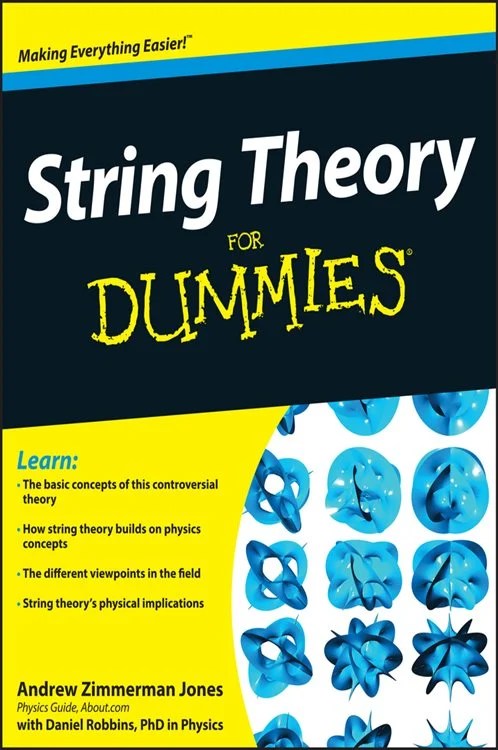
By accident I found a ‘String Theory for Dummies’ book, written by Andrew Zimmerman Jones and Daniel Robbins, and hoped this would at last answer my questions… but it didn’t. Jones’ most relevant claim for credibility as an author in this area is that he is the “Physics Guide at About.com” (whatever that means) and has a bachelor’s degree in Physics from Wabash College. You have to scour the pages for it, but Robbins has a PhD in Physics and studies String Theory at Texas A&M University. Looking on arXiv.org, I could see that Robbins has published some papers in relevant areas.
Overall I found their book to be a huge disappointment. Most of it is not about String Theory, but instead talks about other foundational topics in Physics. When the focus is on String Theory:
* we learn almost nothing about that actual theory / family of theories, * we do not see any of the mathematics, * we do not see predictions that could be tested experimentally.
We are essentially told to trust that it is a great theory, without seeing anything to convince us that the huge focus on studying it is a good investment of academia’s resources.
I could not believe that there is essentially nothing published that would explain to a capable, generally well-informed, non-academic audience, what String Theory actually is.
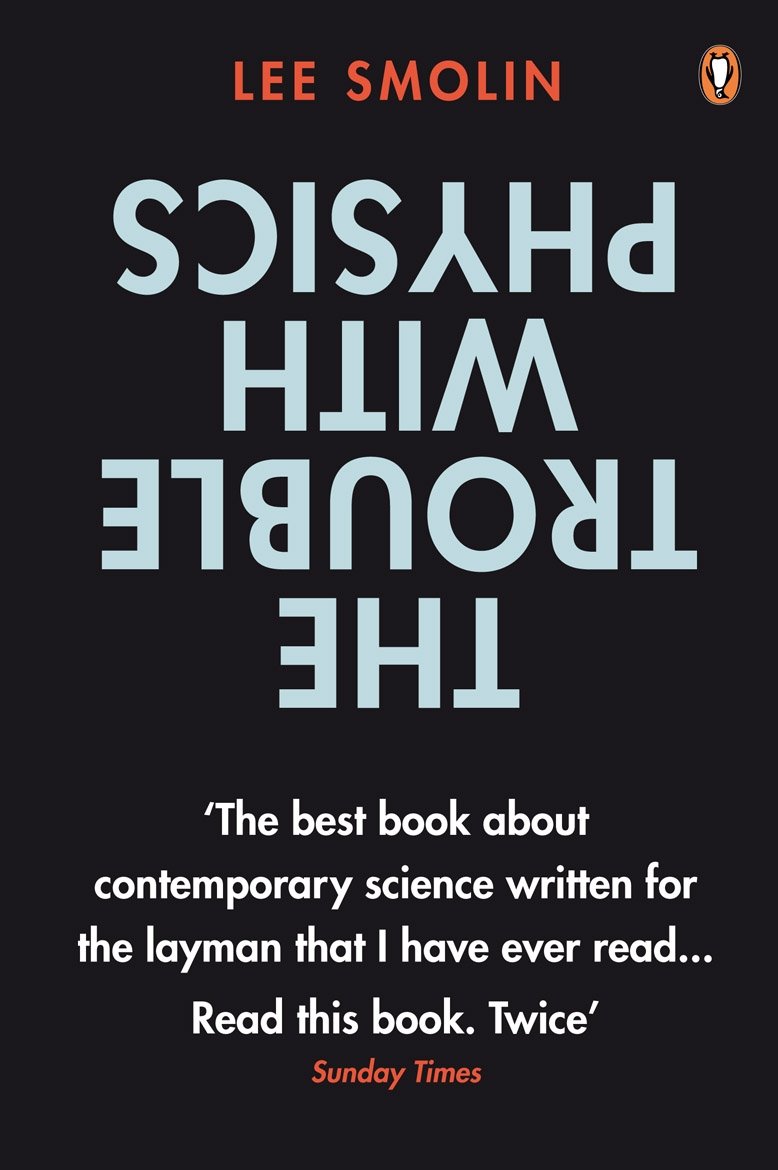
Then I read Lee Smolin’s 2006 book “The Trouble with Physics”, and the mists cleared for me.
Smolin is a theoretical physicist who worked for a time on String Theory, but was not persuaded to devote his career to it. He takes 355 pages to explain why String Theory is not delivering anything like a proper scientific theory, why discoveries in theoretical Physics have essentially stalled, and why the Fundamental Physics community needs to encourage a much broader range of possible approaches towards developing theories for Quantum Gravity and GUTs. I was amazed when he said in chapter 18 “… I can think of no mainstream string theorist who has proposed an original idea about the foundations of quantum theory or the nature of time…”
It seems to me that String Theory has become the ‘Emperor’s New Clothes’ of theoretical Physics, always claiming to be on the cusp of delivering amazing revelations about the nature of the universe, yet never getting there. I will take on trust that, within the String Theory community, the mathematics is quite beautiful… but by itself that is not enough.
I want to know why the universe is like it is… for real… not just a self-gratifying mathematical pipe-dream.
I no longer believe that String Theory will explain the true fundamental nature of our universe, matter, space and time. My focus has shifted to much less trumpeted areas like Loop Quantum Gravity and Roger Penrose’s Twistor Theory. It is now clear that a few people are investigating other approaches for GUTs and Quantum Gravity, despite the PR/media machine that has otherwise created an impression that String Theory is the only game in town. Instead of feeling disappointed by a lack of results in fundamental Physics, I’m feeling excited by all the other innovative ideas that are being pursued.
You can leave a comment on this post, or anything else on my website, with this form.
In 2002 I graduated from the Open University with an excellent (2:1 Honours) Open Science degree, at a time when their fees were much lower. This enabled me to boot-strap my education as an adult, after a pretty lacklustre grammar school experience.
Working from the basement level up, using the OU’s distance-learning materials, I essentially taught myself the foundations of degree-level maths to support my real interests in Astronomy, Physics and Cosmology, and other Planetary Sciences including Geology, Geochemistry and Oceanography. Learning in this way gave me a solid platform for understanding how the physical world works, and left me with a lifelong drive for continual learning.
Decades later, I’m still exploring those physical science themes through personal study and casual reading. There is a reasonable market for so-called ‘popular science’ books which bring to life the concepts from their disciplines without needing a post-doc education. I’ve found many of these very helpful for building my interest and background knowledge, often inspiring me to take my learning further with deeper study. I found the following popular science books both helpful and enjoyable enough to retain them on my shelves… I hope you enjoy them as well!
Physics Fundamentals – Frank Wilczek The Order of Time – Carlo Rovelli Reality Is Not What It Seems – Carlo Rovelli Black Holes – Professors Brian Cox and Jeff Forshaw QED – Richard P. Feynman Surely You’re Joking Mr Feynman – Richard P. Feynman Genius, Richard Feynman and modern physics – James Gleick Through Two Doors At Once – Anil Ananthaswamy In Search of Schrödinger’s Cat – John Gribbin The Biggest Ideas in the Universe #1, Space, Time and Motion – Sean Carroll Dreams of a Final Theory – Steven Weinberg Why Does E=MC2 (and Why Should We Care?) – Brian Cox and Jeff Forshaw Black Holes – Brian Cox and Jeff Forshaw
Cosmology Our Mathematical Universe – Max Tegmark Endless Universe, Beyond The Big Bang – Paul J. Steinhardt and Neil Turok The Inflationary Universe – Alan H. Guth A Brief History of Time – Stephen Hawking The Universe in a Nutshell – Stephen Hawking Before The Big Bang, Our Origins in the Multiverse – Laura Mersini-Houghton The First Three Minutes – Steven Weinberg After the First Three Minutes: The Story of Our Universe – T. Padmanabhan Just Six Numbers – Martin Rees Something Deeply Hidden – Sean Carroll The Big Picture – Sean Carroll The Hidden Reality – Brian Greene The Fabric of the Cosmos – Brian Greene
Astronomy First Light, Switching on Stars at the Dawn of Time – Emma Chapman Water and the Search for Life on Mars – David M. Harland Jupiter Odyssey: The Story of NASA’s Galileo Mission – David M. Harland Beyond Pluto: Exploring the Outer Limits of the Solar System – John Davies Titan Unveiled: Saturn’s Mysterious Moon Explored – Ralph Lorenz and Jacqueline Mitton The Great Comet Crash: The Collision of Comet Shoemaker-Levy 9 and Jupiter – John R. Spencer and Jacqueline Mitton (eds) Satellites of the Outer Planets: Worlds in Their Own Right – David A. Rothery The Worlds of Galileo: The Inside Story of NASA’S Mission to Jupiter – Michael Hanlon
Like most of us, I have a big ‘to be read’ pile! I became fascinated with Leonard Susskind’s lectures a couple of years ago, so my next indulgences will be:
Classical Mechanics – Leonard Susskind and George Hrabovsky Special Relativity and Classical Field Theory – Leonard Susskind and Art Friedman Quantum Mechanics – Leonard Susskind and Art Friedman General Relativity – Leonard Susskind and André Cabannes
You can leave a comment on this post, or anything else on my website, with this form.
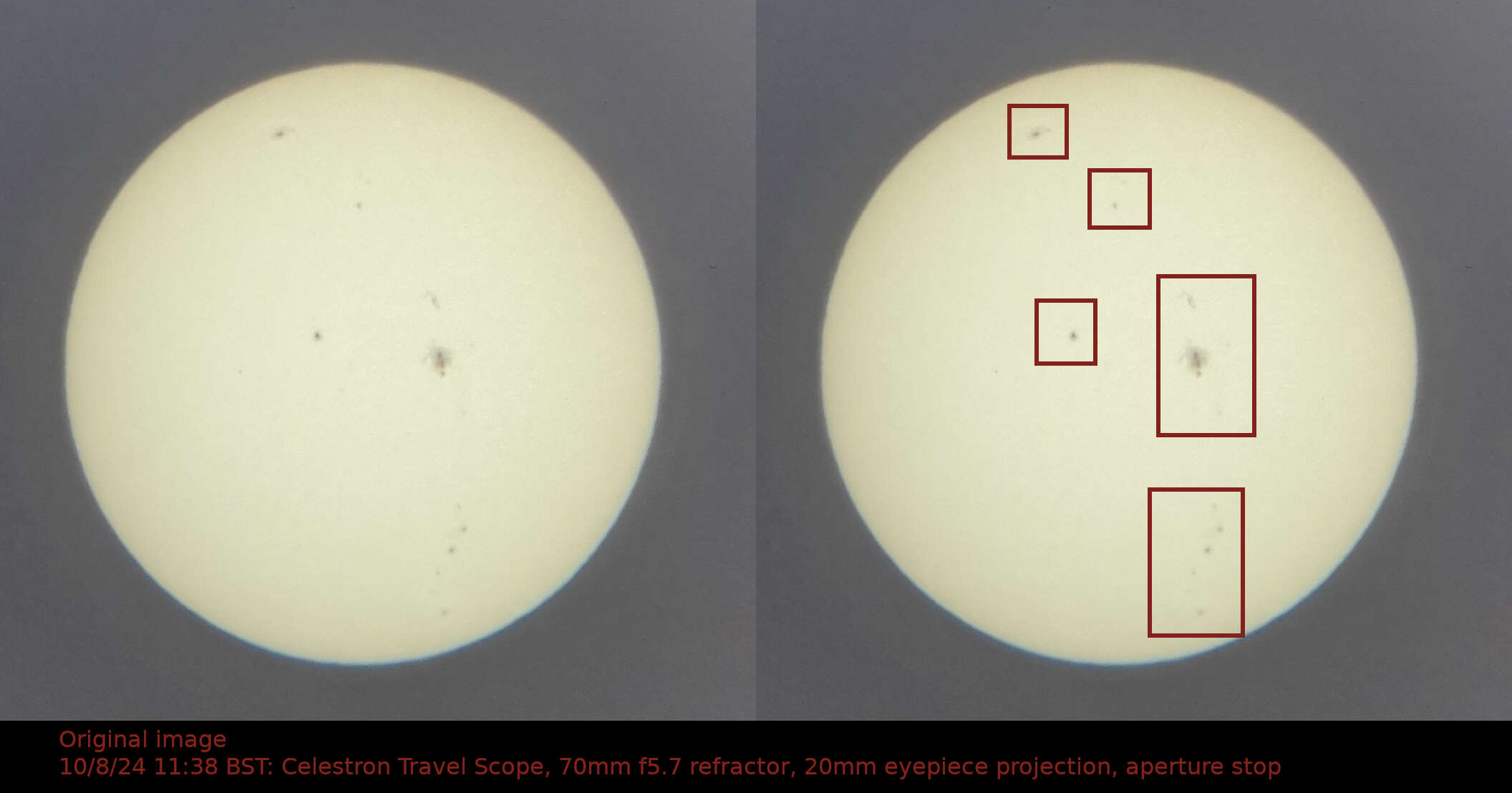
I’ve been indulging my love for Astronomy with a little 70mm / f5.7 refractor that I picked up at the start of the year. This summer was great for observing the Sun via eyepiece projection (don’t try that at home unless you know what you’re doing… I melted the inside of a 10mm eyepiece while I was getting used to this method!), and it has been fascinating watching sunspots evolving over time.
Here’s a couple of my pictures: * The first one is over-exposed and shows the phenomenon of “limb darkening” – the edge of the sun looks darker than the middle because we’re looking through less of the solar atmosphere.
* The second is an example of the sunspots that have been visible this year. In the larger box on the RHS with 2 sunspots, the darkest area (umbra) is where the magnetic field lines are nearly vertical and we’re seeing deeper into the Sun’s atmosphere than the greyer around surrounding it (penumbra) where the field lines are more inclined.
You can leave a comment on this post, or anything else on my website, with this form.
My working life in the corporate world is finally coming to an end – woo hoo!
I officially retire on 31st December but will be on garden leave soon – magic! I’m really looking forward to my “real life” to come as a proper person, not an employee… including reconnecting with friends, writers and all the new people I’ve now got time and energy to connect with.
It’s been 39.2 years coming, but my wife’s t-shirt gift for me says it all!
You can leave a comment on this post, or anything else on my website, with this form.
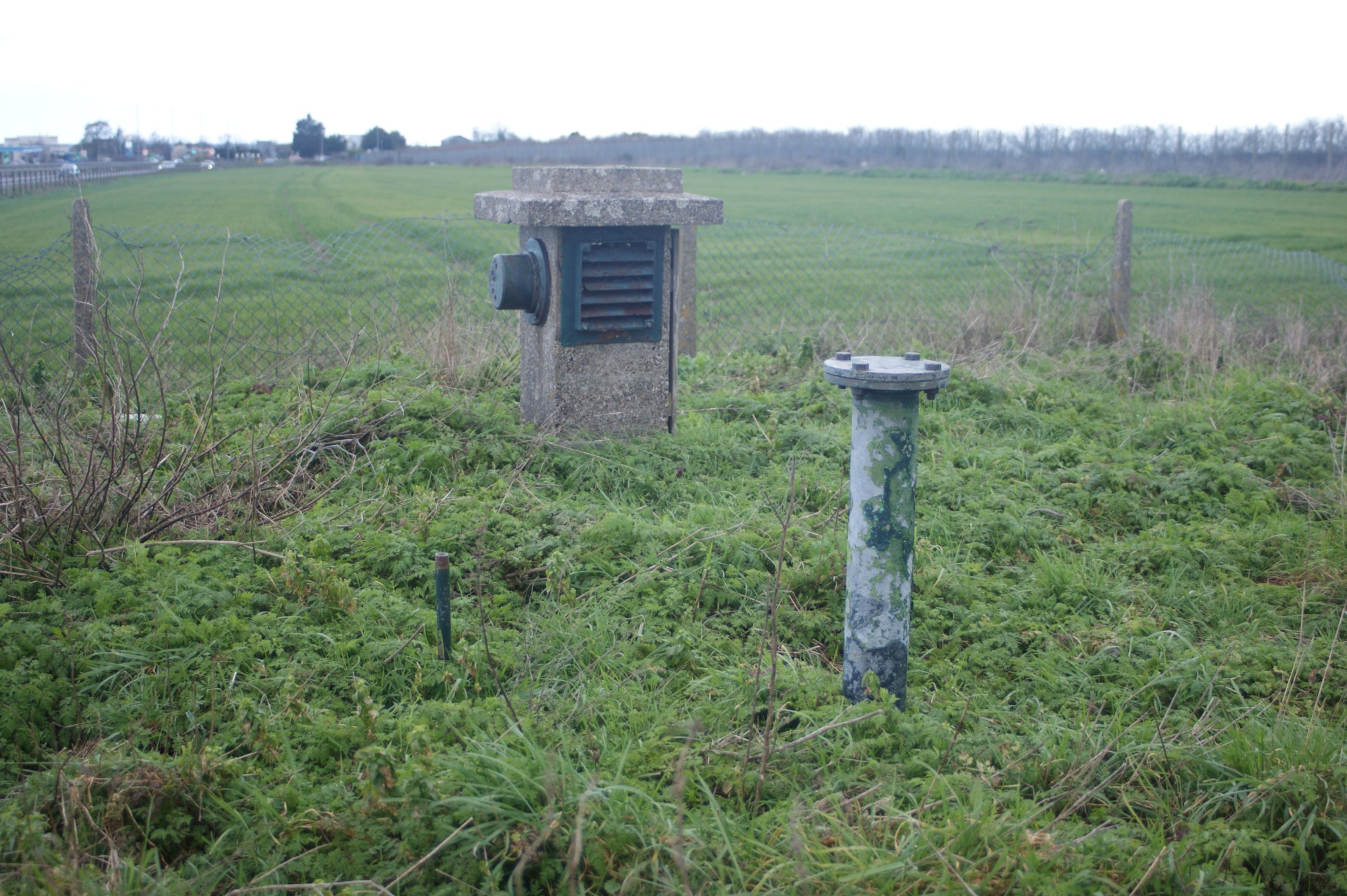
Decades ago I saw two men climbing out of a hole in the ground just outside the perimeter of the former RAF Manston. I had always wondered what they were doing there, and last February I took a walk along the now abandoned road in that area to investigate.
I found a derelict ROC Observation Post in a very poor state of repair. The hatch was missing and the entrance shaft was missing its ladder. Even so, the main external features of this bunker were visible: the entrance hatchway, ground zero indicator mount, air vent, bomb power indicator baffle plate. For the ROC personnel manning these bunkers, conditions underground would have been quite cramped but I did not try to take a look here. There are good schematics of ROC posts available online, and the following two web pages give a reasonable overview:
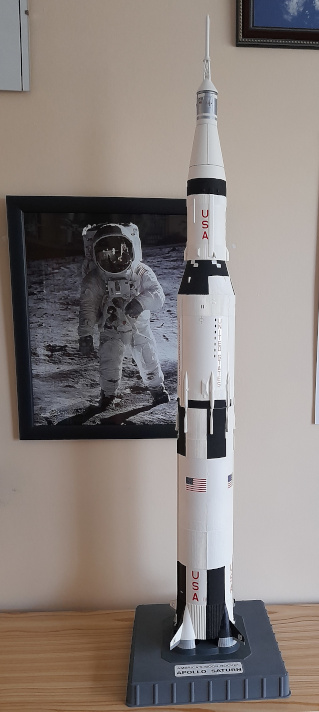
I’ve always been interested in the technology of spaceflight, and particularly the 1960s solutions to the problem using the Saturn-V launcher. I think it is the complexity of the machine, combined with its extraordinary thrust and the drama of being the first to take humans to the Moon that is so captivating.
I was not excited by maths at school and have since worked hard to grow my mathematical abilities… its become a life-long project since my twenties to see how much I can learn as an adult. It had always annoyed me that my mathematical prowess is less than many people could achieve in the ’60s… spaceflight, general relativity, quantum mechanics… all things to be understood and conquered!
I’m really pleased to have grown my ability to mathematically understand spaceflight by constructing my own mathematical model of how Apollo 11 moved from the launch-pad to Earth-parking orbit (EPO). Using three separate stages (the S-IC first stage, S-II second stage, and S-IVB third stage) with a combined and fuelled mass of c2,938,315 kg, my calculations show that Apollo 11 used 2,894,920 kg of burnt fuel and discarded stages to reach EPO. Just 1.5% of the launched mass was subsequently needed to reach, land and return from the Moon (43, 395 kg).
In my mathematical model, Apollo 11 reaches EPO at 203 km altitude, moving at a speed of 7,791 m/s. The actual spacecraft had an EPO at 191 km, moving at 7,383 m/s. Given that my model treats the vehicle as a point mass and computes changes at 1 second intervals, I’m proud that the error in my calculations equates to less than 1.7 s of flight for the real vehicle. This pdf document summarises key results from the model.
You can leave a comment on this post, or anything else on my website, with this form.
















 Lee J. Russell, Author
You must be logged in to post a comment.