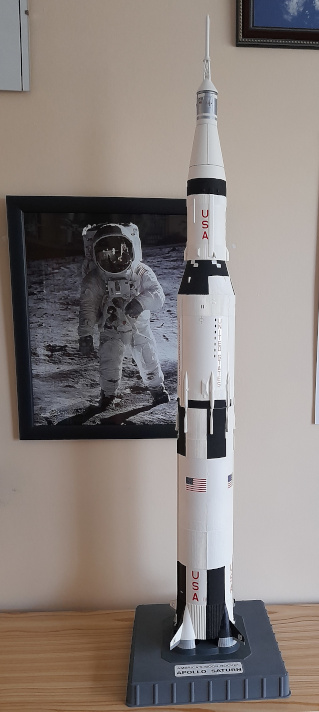
I’ve always been interested in the technology of spaceflight, and particularly the 1960s solutions to the problem using the Saturn-V launcher. I think it is the complexity of the machine, combined with its extraordinary thrust and the drama of being the first to take humans to the Moon that is so captivating.
I was not excited by maths at school and have since worked hard to grow my mathematical abilities… its become a life-long project since my twenties to see how much I can learn as an adult. It had always annoyed me that my mathematical prowess is less than many people could achieve in the ’60s… spaceflight, general relativity, quantum mechanics… all things to be understood and conquered!
I’m really pleased to have grown my ability to mathematically understand spaceflight by constructing my own mathematical model of how Apollo 11 moved from the launch-pad to Earth-parking orbit (EPO). Using three separate stages (the S-IC first stage, S-II second stage, and S-IVB third stage) with a combined and fuelled mass of c2,938,315 kg, my calculations show that Apollo 11 used 2,894,920 kg of burnt fuel and discarded stages to reach EPO. Just 1.5% of the launched mass was subsequently needed to reach, land and return from the Moon (43, 395 kg).
In my mathematical model, Apollo 11 reaches EPO at 203 km altitude, moving at a speed of 7,791 m/s. The actual spacecraft had an EPO at 191 km, moving at 7,383 m/s. Given that my model treats the vehicle as a point mass and computes changes at 1 second intervals, I’m proud that the error in my calculations equates to less than 1.7 s of flight for the real vehicle. This pdf document summarises key results from the model.
You can leave a comment on this post, or anything else on my website, with this form.


You must be logged in to post a comment.