Honduras has just ratified the Treaty on the Prohibition of Nuclear Weapons, meaning that the minimum number required for it to come into force has been reached.
There are currently 193 member states of the United Nations – 122 (63%) of them have approved the accord on the Prohibition of Nuclear Weapons.
Now 50 states (26% of UN membership) agree that they will “… never under any circumstances develop, test, produce, manufacture, otherwise acquire, possess or stockpile nuclear weapons or other nuclear explosive devices.“
This a great step towards ridding the world of these most terrible weapons of mass destruction. A most significant next step would be to see a real move towards to reducing stockpiles and nuclear disarmament by the 5 main nuclear powers: United States, Russia, China, United Kingdom and France. – these 5 states are essentially holding world safety up to a nuclear ransom… isn’t it time that things changed?
NASA is hopefully going to grab up to 2kg of rick samples from asteroid Bennu and give us a fantastic insight into early planetesimal formation in the solar system…
The spacecraft’s first attempt to gather material from the space rock’s surface could become the largest nonlunar sample return in history
First up was a re-read of “Sigmet Active” by Thomas Page (1978). I had read this around 1982 and it stayed lodged in my imagination ever since — but would it be as good now? The answer was “yes and no”.
‘Sigmet’ is a pilot’s notification of significant meteorological activity. Sigmet conditions make flying very risky and inadvisable. Page blends a fictional US Cold War secret weapons project with the McGuffin of a living plasma in the ionosphere to create a so-so sci-fi thriller. His idea for ‘Project Windowpane’ is plausible enough. The Navy fire an experimental high-power laser at the ozone layer which ‘burns’ a 2-mile wide hole above a test ship called the Knoxville. Windowpane seems to be a success when heat and radiation from the ‘window’ that the laser has opened kills test animals on the Knoxville.
Windowpane unbalances electrical charges in the ionosphere. The ‘plasma creature’ usually maintains the charge balance with lightning. It somehow becomes imprinted with the electrical signatures of every living creature on the surface below the window. A science crew were watching the test from a hardened bunker on an island called Itrek. The plasma creature first kills the easy lower organisms on the island with lightning before attacking the bunker. They survive but their ship, the missile destroyer Adair, is also destroyed by lightning attacks. The main protagonist, Itrek survivor Jeffrey Holden, is then chased around the world by storms created by the plasma creature. Other minor characters are killed off and there is an almost unnecessary love-child side-story.
“Sigmet Active” does still echo with some of the Cold War sentiments that I remembered. Yet, it is also diminished by the prominent homophobic sentiments of ‘Chief Petty Officer Mason’. It is a quick read (218 pages) and yet somehow Page seems to miss the mark. This time around it was neither deep enough on the science elements nor thrilling enough in the chase sequences to keep a strong hold on my interest.
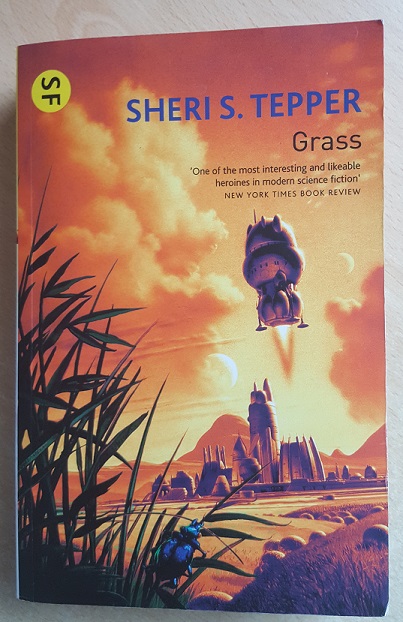
Next up is “Grass” by Sheri S. Tepper (1989). This a rock-solid, classy and engaging story that I have not hesitation in recommending. A plague is sweeping across the inhabited galaxy and only the people on the planet Grass seem to be immune. In a diplomatic mission, the Westridings are sent from Earth to learn their secret.
Decadent aristocratic families known as ‘bons’ (like the bon Damfels or bon Haunsers) call themselves the rulers of Grass. They lack education and the ability to support or maintain themselves. As the story progresses it becomes clear that the people in the Commoner Town are experts in technical fields and the real powers on Grass.
The Westridings spend a lot of time interacting with the bons, who hold themselves aloof. Eventually, Lady Westriding builds more productive relationships with the commoners.
Tall, multi-coloured grass prairies cover almost the entire surface of the planet. Ferocious ‘foxen’ and nightmare horse-like ‘hippae’ live on the prairies are the dominant macro-animals. There is a very dark secret to discover about the circle of life between bats, hippae, foxen and humans, and the ultimate cure for the plague.
The bons behave very strangely during “hunts” when they ride hippae to chase down foxen, which opens a way to reveal the immunity secret. The book never feels slow and Tepper uses several sub-plots to keep us interested as the story unfurls. Grass has a soft mysticism a bit like Dune with such a strong sense of place that you feel like you’ve been there. Recommended.
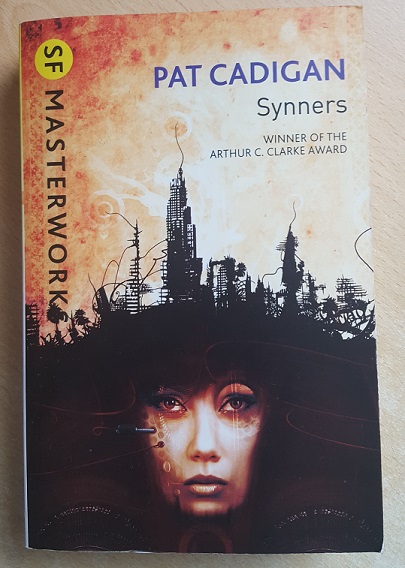
Last up is “Synners” by Pat Cadigan (1991), riding the cyberpunk wave from William Gibson’s “Neuromancer” (1984). I found Cadigan’s tale interesting, but also slow and at times held back with poorly positioned street slang. Her future society is a grimy blend of computer hacking, virtual realities, implanted technology, drugs, streetwise punks, sex and amoral corporations.
The global internet is full of viruses, some helpful, some fun, others dangerous. It now hosts a dataline that beams more information into households and businesses than they could ever consume. This internet controls everything and society would struggle if it was damaged. Many of the main characters create films for the entertainment dataline. They have a strong sub-culture that feels like “sex, drugs and rock & roll”, and the best videos get elevated to a kind of celebrity status. One such creator is a genius known as ‘Visual Mark’, whose atrophied brain has become hyper-focussed on producing images.
Cadigan invents a technology called “sockets” which enables people to connect their brains to the internet for entertainment. The ‘Diversifications’ corporation gets control of that technology and fits sockets to Visual Mark. They don’t know that sockets don’t have anti-virus protections and he is about to have a stroke (‘the big one’). Visual Mark achieves a transference of his consciousness onto the internet via his sockets, barely regretting leaving behind ‘the meat’ that he has outgrown. Unfortunately when he does have the ‘big one’ it also unleashed as the most destructive virus possible on the internet. Other protagonists must then work together to stop this virtual manifestation of the ‘big one’.
There are other sub-plots within the book, but that is part of the problem with ‘Synners’. The ideas are huge but the story crawled through a combination of too many main characters, abrupt scene shifts, confusing slang and an overdone music industry culture that I wasn’t excited about.
Before I finally close my old “russellweb” domain I thought I’d take a look at where the ongoing hacking attempts are coming from. Given that I don’t advertise this old domain (having moved here) and haven’t posted anything new there for months, activity comes from either bots/indexers or hackers… and hacking attempts are very obvious based on the (non-existent) files they are trying to access.
<= I noticed an immediate increase in hacking once the wave-1 Covid lockdowns started to ease across the globe. This is what the story looked like in yesterday’s log files.
I hope everyone is now using ultra-secure, non-repeated passwords with 2-factor authentication wherever possible. The criminality behind these hacking attempts is obvious – if they’re trying to do this on a small mothballed ‘hobby’ site, what are they doing to sites with full e-commerce capabilities and all of our personal details?
I started writing sci-fi short stories around 2009, and by 2017 had self-published two novels and an anthology. That had been enjoyable but hadn’t sold very well, so by 2019 I had decided to switch to writing Thrillers. Having reached the mid-point of a first draft for book 2 in my new ‘Lissa Blackwood’ series I decided to take a short break, to recharge and reconnect with my muse.
The rest was superb – I read a lot of books, watched a lot of films and generally relaxed.
And in that relaxation I discovered that my true muse is the experience of living during the closing years of the Cold War. Memories of cruise missile launchers prowling the English countryside, CND protests, posturing by Reagan, and films like Threads, all combined to leave me with a significant fear of nuclear war. That theme came out a little in my first two novels, but I can now see how to really focus on it through my Lissa Blackwood stories.
I’m now working on four projects that will help me to dig deeply into my Cold War memories and emotions:
A series of circa 35 non-fiction articles about the Cold War,
12 short stories set within or around Cold War nuclear bunkers,
7 short stories based around the fiction ‘Special Investigations Group’ (SIG) that I created for my series of ‘Lissa Blackwood’ thrillers, and
The first 3 novels in my ‘Lissa Blackwood’ series.
It feels great to be writing again, and I’m enjoying exploring both the creative fiction and historical exploration of the Cold War era!
====== image: Titan Missile by Mike McBey on flickr.com – CC BY 2.0 license.
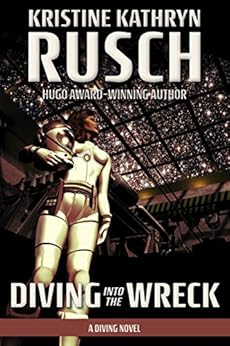
I’ve been reading a lot more fiction since my Covid-19 lockdown began on 13th March. My interests are quite varied but I often return to my first love, science fiction – and I’m pleased to say that this 2013 tale from Kristine Kathryn Rusch did not disappoint!
I’ve had a soft spot for stories like this ever since I read a book about potholing accidents at school. Rather gruesome, I know, but what it kindled was a fascination about the exploration of confined spaces. A few years later I spent a miserable afternoon on an out-of-bounds course crawling around part of an abandoned coal mine – it was cold, wet, physically demanding and very painful… and not something I wanted to take up as a hobby!
Fast forward a couple more years and my interest in geology combined with trips to the famous limestone cave systems in Cheddar Gorge, Somerset, UK. Reading about cave diving convinced me that I didn’t want to do that either (I value my life far too much), but I did enjoy reading Martyn Farr’s seminal book on the topic, ‘The Darkness Beckons’.
Like an armchair quarterback, I can’t do it myself but I feel educated enough to have an opinion. And my opinion is that with ‘Diving into the Wreck’, Rusch has created a very authentic tale about how, in the future, people might explore (or pillage) abandoned spacecraft wrecks. These wrecks are full of dangers like sharp edges that could cut into a spacesuit, or desperate survivors of deep space accidents, malfunctioning technology or marauding pirates.
Like cave divers, once inside a wreck her explorers take care to be tethered and map their routes, use caution near constricting tunnels or entrances, and pay close attention to their suit’s environmental systems, especially their oxygen supplies. The way they move around sounds a bit like swimming in the darkness of a cave, with their lights showing the way ahead while the areas behind fall into darkness.
The story comes to life in the relationships between a wreck explorer called ‘Boss’ and the team she hires to help her explore her latest find, an old ship called a Dignity Vessel. This ship could be extremely valuable. Unfortunately, it carries a piece of very dangerous technology, called a stealth field, that killed her mother and will now both tempt and scare her crew in different ways. Throw in a back-story about her father and contemporary military tech research and you have an excellent three-part book.
The only strange thing was that, despite my personal interests and Rusch having created a series of books in this setting, I don’t feel any need to read any more stories from her ‘Diving’ series. This one seemed pretty complete and the characters weren’t so compelling that I’d want to read any more about their lives. Still, a good story, well told – this one scores a solid 9/10 on the O2-tank scale.
Every author has to decide on how to present their name when publishing work…
Do you go for the straight first namefollowed by last name format?
Or first initialfollowed by last name?
How do you present any middle names?
Should you reverse your names for impact as a pen name, or even discard your own identifiers and use something completely different?
The choice about whether to use a pen name will be driven by many factors, including a desire to maintain anonymity or wanting to match the prevailing style in your chosen genre. But whether we’re using a pen name or not, the same question arises – how should I format my author name?
I decided to let some research inform my choice.
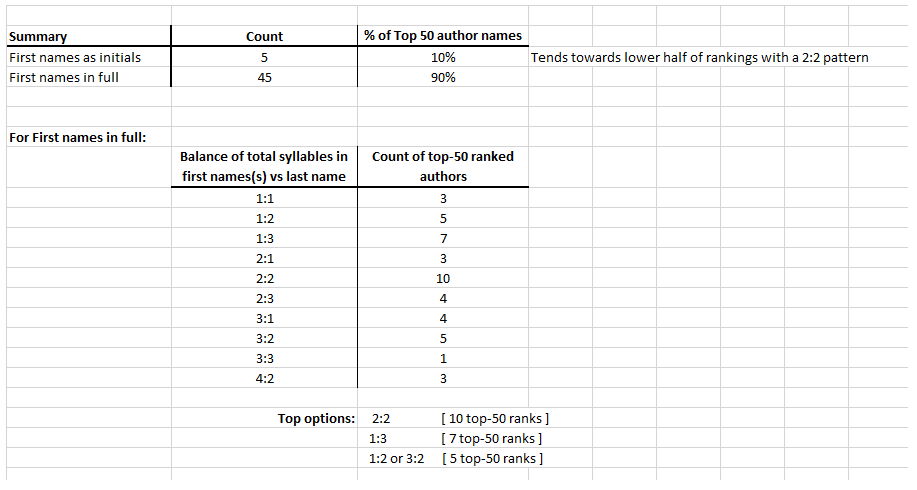
I looked at the top-50 ranked science fiction authors in a large online survey and broke their names down into 2 categories:
initialsfollowed by last name, or
first name(s) followed by last name.
I then counted the syllables in the individual parts of their names (initials counted as 1 syllable each), and expressed them in this ratio:
Count of all syllables before the last name vs Count of syllables in last name
– here are three examples:
The conclusion was that using initials is not usual (just 5 from 45 authors had chosen that style), and a 2:2 balance in the names was most common.
I found this very helpful when revising my author name to match available .com domain names – I settled on:
Author name – Lee J. Russell
Domain name – leejrussell.com
Here are the full results – do they help you to choose how to format your own author name?
I have a huge soft spot for early, post-WW2 SF, and this collection, chosen by Asimov, did not disappoint.
The book collects 12 stories from 1939 to 1972 that he considered to be good stories spanning three decades of writing: “… two early examples, two late samples, and eight from the gold decade (for me) of the Fifties.”
I loved his suggestion of an alternative title for the collection as “The Pretty Good and Pretty Representative Stories of Isaac Asimov” – he was a humble man, it seems.
The twelve stories are:
Marooned Off Vesta (1939), Nightfall (1941) – his masterpiece, C-Chute (1951), The Martian Way (1952), The Deep (1952), The Fun They Had (1954), The Last Question (1956), The Dead Past (1956), The Dying Night (1956), Anniversary (1959), The Billiard Ball (1967), and Mirror-Image (1972)
‘Nightfall’ needs no introduction from me – it is one of the most singularly imaginative SF stories ever written. This story was read by Steve Ely for the One Hundredth edition of the ‘Escape Pod’ podcast – Steve (now Serah) gave it a respectful and energetic reading, which I recommend listening to.
I loved ‘The Billiard Ball’, which I am not going to spoiler zone here – it features a well thought out revenge-murder.
Mr Asimov’s personal favourite was ‘The Last Question’, but it seemed no better than the rest of the collection to me.
My personal favourite was ‘C-Chute’ – I loved the idea of a desperately homesick man going to extraordinary lengths in order to avoid becoming a prisoner of war. There is a also a pretty good audio performance of this story available from the “X-Minus One” radio shows.
One confusion I have is why Sphere decided to publish this 1973 UK version of the book with that terrible cover? It says nothing about the genre or overall themes of the stories – why would anyone have chosen that for an SF book?




 I’ve had a soft spot for stories like this ever since I read a book about potholing accidents at school. Rather gruesome, I know, but what it kindled was a fascination about the exploration of confined spaces. A few years later I spent a miserable afternoon on an out-of-bounds course crawling around part of an abandoned coal mine – it was cold, wet, physically demanding and very painful… and not something I wanted to take up as a hobby!
 Reading about cave diving convinced me that I didn’t want to do that either (I value my life far too much), but I did enjoy reading Martyn Farr’s seminal book on the topic, ‘The Darkness Beckons’.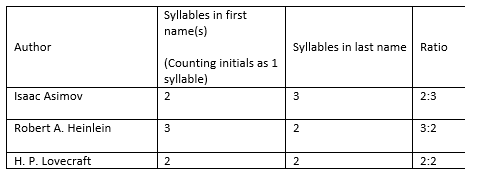



You must be logged in to post a comment.