These images show an interesting cluster of sunspots that were visible in white light on 8th October:
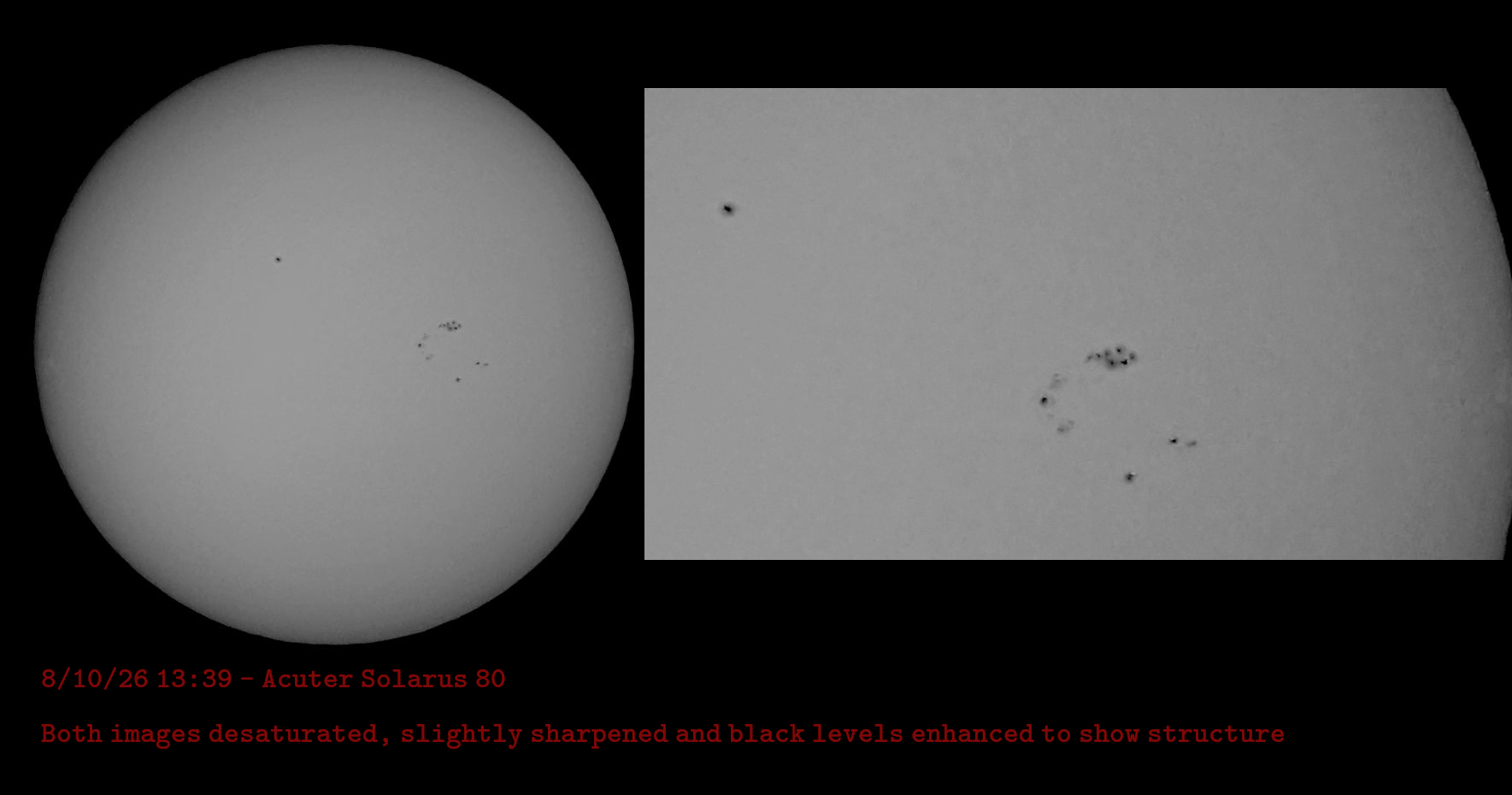
One of my friends asked, “What does that mean though?” That’s a fair question… and sometimes I forget that people don’t generally know these kinds of things!
Here’s my answer to that excellent question: “The Sun is a dynamic place, formed (mostly) from a plasma of electrons (negative charge) and protons (positive charge, hydrogen nuclei). These particles are constantly convecting (a bit like water in a saucepan) and their motions are affected by strong magnetic fields in the Sun.
Sunspots are areas where the magnetic field is pointing upwards, away from the surface, allowing us to see a little further inside. Temperature is a bit lower beneath the surface we usually see, so the sunspot areas look a bit darker by contrast.
Because the Sun is so dynamic, the numbers of sunspots is variable, depending on how the magnetic field lines are changing.
And that’s it… sunspots don’t indicate problems… they’re just natural phenomena in an extreme environment – and interesting to observe!”
Interestingly, another friend took a hydrogen-alpha image of the Sun at the same time, and it is rather unexciting. H-alpha emission mostly occurs just above the visible surface (the photosphere) in a region called the chromosphere – physical processes are different between the 2 regions, and images of them are generally different… just another example of how complex and fascinating the Sun is!

