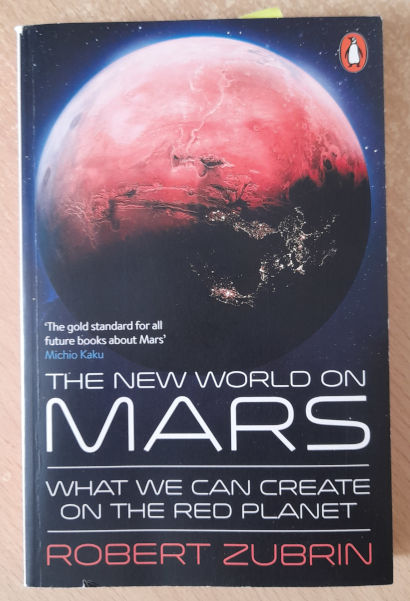
In the ‘New World On Mars’, Robert Zubrin lays out what is obviously a thought out programme for how Mars might be colonised by human beings.
The book considers both the physical demands for how to travel to Mars and then develop a stable colony utilising in situ materials as much as possible, and the social demands for creating stable Mars cities.
His reflections on how the Starship being created by Space-X could be used to (relatively) efficiently transport colonists and cargo to Mars at reasonable costs are well-explained. For the first time I felt that this Space-X project of Elon Musk’s wasn’t just a mad, vanity-driven escapade from a man with too much money and time on his hands. What I had missed was how scaleable the systems to build, launch, maintain and re-use the Starship spacecraft are, and how that re-usability could (again, at scale) include the refuelling and maintenance of Starships on Mars. All the while my thinking was locked into the one-off, high-cost approach previously taken by national government enterprises, I missed realising that Space-X were now doing something that could totally transform space travel.
Zubrin also discusses the extensive availability of mineral and water resources in a way that shows how, if done deliberately at scale, covered colonies (cities) could be created that are largely self-sufficient in terms of the basic needs for food, water, air and shelter from radiation.
In these terms, I agree with the cover quote from Michio Kaku that this book has set “… the gold standard for all future books about Mars.”
However, the programme laid out by Zubrin in this book also has some problems, which at times (as a European reader) irritated me immensely.
Firstly, he rightly calls out that insolation on the surface of Mars is less than that received on Earth. However, he says that “… sunlight is only 40 percent as strong on the Red Planet as it is on Earth” (p. 85). NASA, on the other hand, has said that “… the net average annual solar radiation incident upon Earth and Mars is 209 W/m² and 126 W/m²” (Design Of An Unmanned Martian Polar Exploration System – 1994, page 5.19). The NASA estimate is that Mars receives 60% of the surface insolation on Earth – ie it is 40% less, but 60% as strong.
Secondly, he relies intensely on the repeated idea that Mars colonists will principally power their systems via fusion reactors. These reactors do not currently exist in a functioning state that could be sent to Mars, and it is not yet clear if the technology can cross the threshold to becoming a mainstream power source. Zubrin then seems to rely on an argument that, since innovation will need to be very high on Mars or colonies (cities) will fail, the colonists will find ways to make this technology work out of extreme necessity. This seems like a flawed argument to me, and power constraints could be a much larger brake on Mars colonisation that Zubrin suggests.
Thirdly, he is fixated on reaching Mars using Space-X Starship style rockets. Other researchers are already blending that technology with ideas for a Space Elevator, that could transform the costs, cargo potential and transit times for journeys to Mars. Of course, the technology for a Space Elevator does not exist yet either, but that just puts it in the same camp as fusion reactors.
Fourthly, from a social perspective, in the latter chapters of the book devoted to ‘Social Customs on Mars’ and ‘Liberty on Mars’, Zubrin repeatedly asserts that the social customs adopted in the USA are the best model for a future Mars colony. His argument here seems to descend into a stereotypical “USA is best” approach, which feels pretty arrogant from a nation that is just around 240 years old.
Given recent events with the second Trump administration in the USA, Zubrin’s argument that the USA style of government will be best for Mars colonists now seems very suspect. Zubrin himself says that the USA approach includes ‘monarchical (the Presidency) elements’ and that ‘a monarchical element… can easily devolve into dictatorship unless watched over by a body sophisticated enough to know the political game’ – unless the world outside of the USA has got it wrong, this does seem to have happened, and therefore a different style of government will likely be needed on Mars.
So in summary, this is a good book that gave me a lot to think about. But it also has its flaws, and is not a boilerplate programme for achieving the colonisation of Mars. And there is more to the Earth than the USA.

