I hold an Open Science degree from the Open University. My main areas of interest include Maths, Physics, Geology, Oceanography, Astronomy, Cosmology and Environmental Politics.
Astronomy
Resource: Observation Form (Open Office .odt file).
Resource: Lunar Eclipse exposure table.
If you are interested in taking your own pictures of a lunar eclipse, the exposure details given on this table might be a starting point – I used them to photograph the eclipse of 9/1/2001.
Resource: Python script for epoch conversion.
I like using “Burnham’s Celestial Handbook”, but the 1950s epoch coordinates quickly get frustrating, as we’re mostly using J2000 now. I created this Python script to quickly convert from 1950s to J2000 (you will need ‘astropy’, of course) – you’re welcome to pick it up (see disclaimer directly below) from my area on ‘Pcloud’ (Europe’s secure & private cloud store, avoiding United Statesian tools).
– Disclaimer:
1 – No warranty is implied or given for this script.
2 – You are responsible for checking the appropriateness of running it on your machine.
3 – By running/using the script, you accept and agree that Lee J. Russell will not be held responsible for any damage or loss of data that might occur when running it.
Article: Collimating a Newtonian telescope.
Article: Calibrating the field of view of your eyepieces .
Article: Determining the limiting resolution of your telescope .
Article: Retrograde motion of Mars .
Article: Total Solar Eclipse – Amiens
In 1999 I went to Amiens to view the total solar eclipse. This link will take you to the results of my light-level observations during the eclipse: Results of observations from August 11 1999 Total Solar Eclipse. These results were published in both the British Astronomical Association’s official CD-Rom on the event and Eclipse, Vol 28 No. 3 (The journal of the South East Kent Astronomical Society).
Practical Observing
Now I have retired I am able to devote a lot more time and energy to developing my observing skills. Having never used a “GoTo” telescope before, I have just spent a fraught 7-8 months learning how to use a new 6″ refractor mounted on an HEQ5 Pro mount. There were many misunderstandings and problems that I have needed to overcome, and I am still early on the learning curve, but I am now ready to start using this new telescope in a methodical manner.
My current areas of interest are visual observations of the planets, binary (or more) star systems and variable stars. I also use a 2.8″ (70mm) refractor to view the Sun via eyepiece projection… with a slow side project to hook my DSLR to this tube for direct imaging via a solar filter. And I’m on the look out for a simple (cheap) alt-az mount for my old 6″ reflector, for simple observations of the Moon and Planets when time is short.
Equipment
6″ Sky-Watcher Startravel-150 refractor, mounted on an HEQ-5 PRO mount with their SynScan controller: this is my current main telescope.
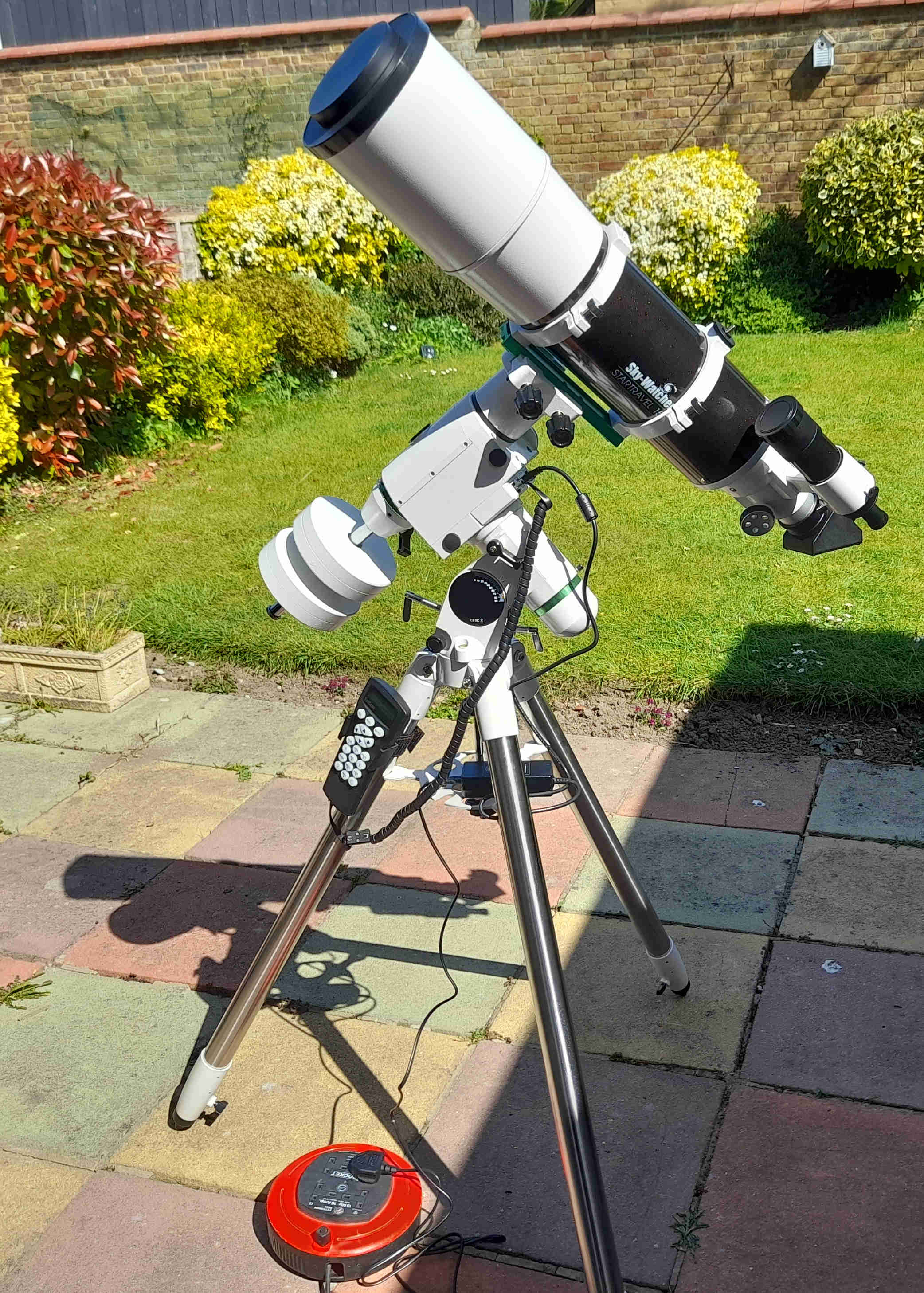
I have only just got this working satisfactorily. My initial reaction is that the main optics are very good. I was amazed by a low-power view of Jupiter on 18/11/25 (x75) showing more detail in the cloud bands than I can see with my 6″ reflector at the same magnification. The ‘scope then continued to show a good, sharp image up to x200 magnification. Stars are clear with good colour contrast, right across the field of view.
With effort, I am getting about a 5 arc-minute GoTo error from the mount, which I now understand is about as good as that will get (more accurate pointing would require a significantly more expensive mount, probably with encoded shafts on the RA/Dec axes).
For anyone looking to buy a similar telescope, I have some words of caution:
1) The instruction books that came with the mount and OTA initially looked as if they were very thorough, until I realised that a lot of information was missing and what was given was often confusingly expressed. It took a lot of support from the vendor, YouTube videos, information gleaned from the internet using ChatGPT and my local astronomy club (SEKAS) to clarify my understanding, solve problems, and ultimately achieve a satisfactory setup.
2) The dovetail bar the tube was supplied on was too short to achieve a good balance, and I had to buy and fit a longer bar. Anyone wanting to do that on a similar Sky-Watcher telescope should note that the fittings are US-Imperial, not UK-rest-of-the-world metric, so you will need Imperial tools, bolts etc.
3) The provided rack-and-pinion focusser was of poor quality and wholly deficient for any reasonable use (and a major source of circa 50 arc min perceived pointing errors). I have replaced that with a Crayford focusser which seems to be much better.
4) I have also fitted a dovetail bar “piggy-back” on the tube, and a new finder scope bracket to that, as the original position of the finder was extremely uncomfortable.
Having solved these problems, I am now ready to make good use of this new telescope!
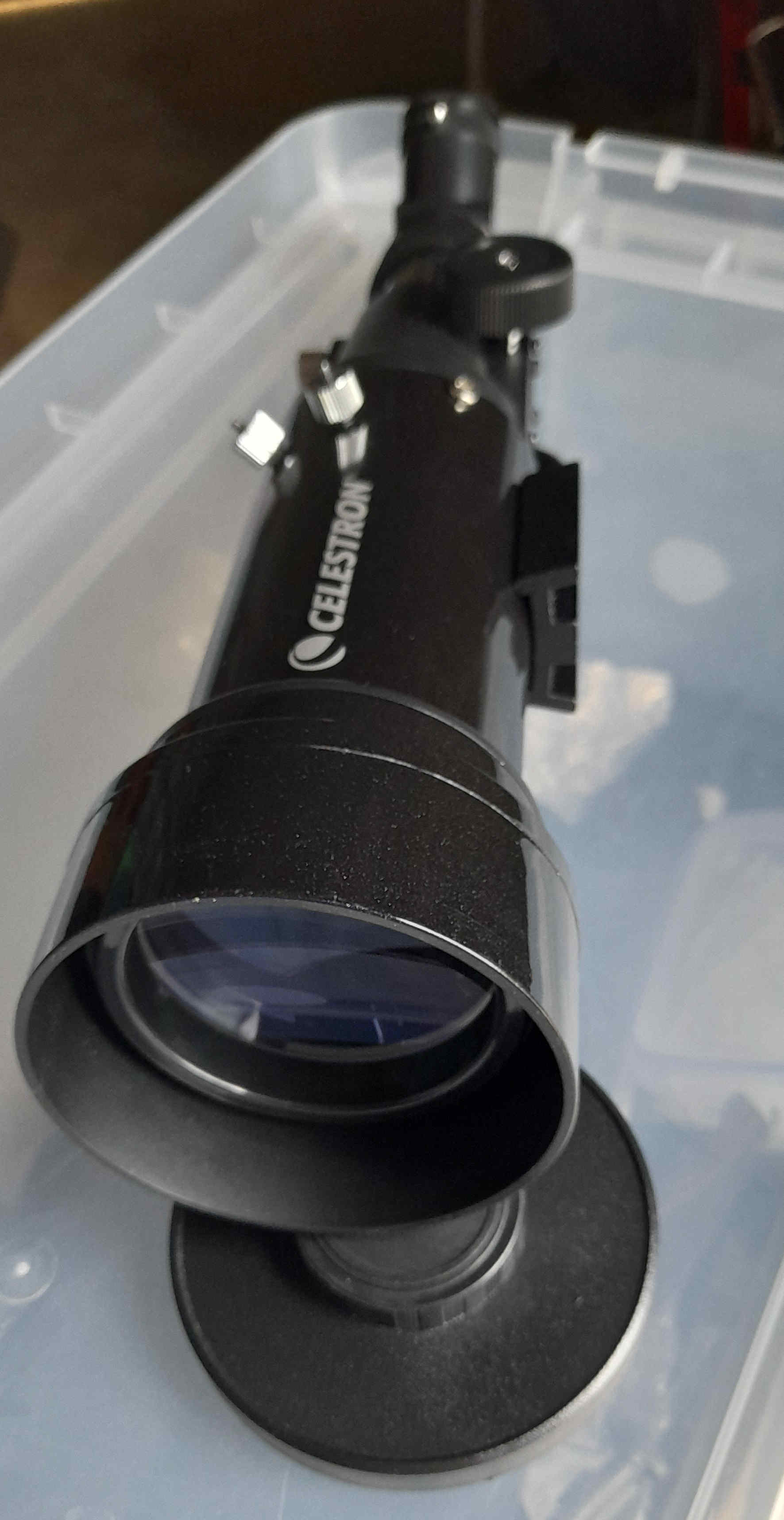
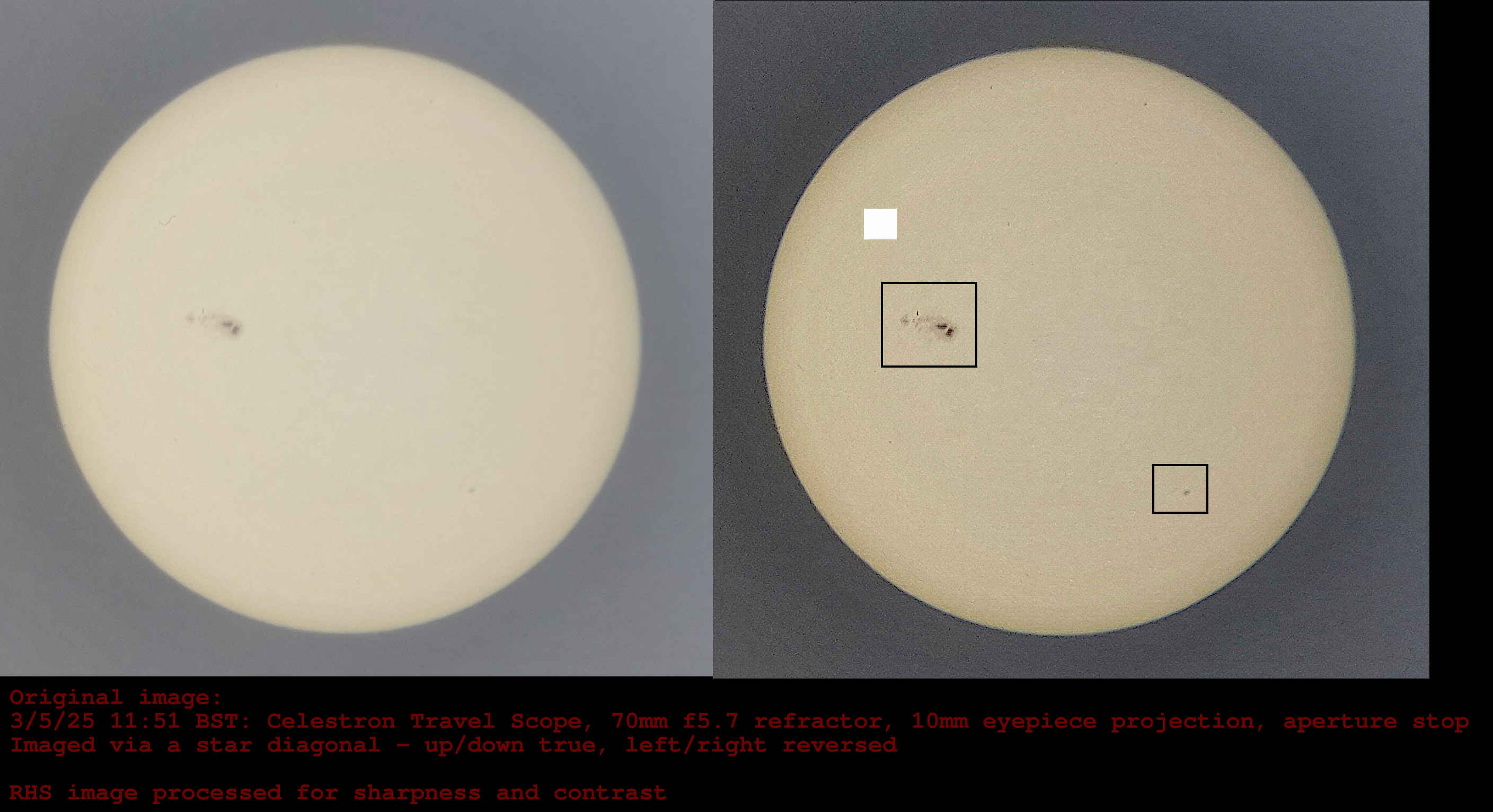
2.8″ (70mm) Celestron f5.7 refractor (‘Travel Scope’) – solely used for viewing the Sun.
Here is an image I have taken using this ‘scope with eyepiece projection:
6″ ‘Europa 150’ Newtonian reflector from Orion Optics – I have been using this telescope since 1998.
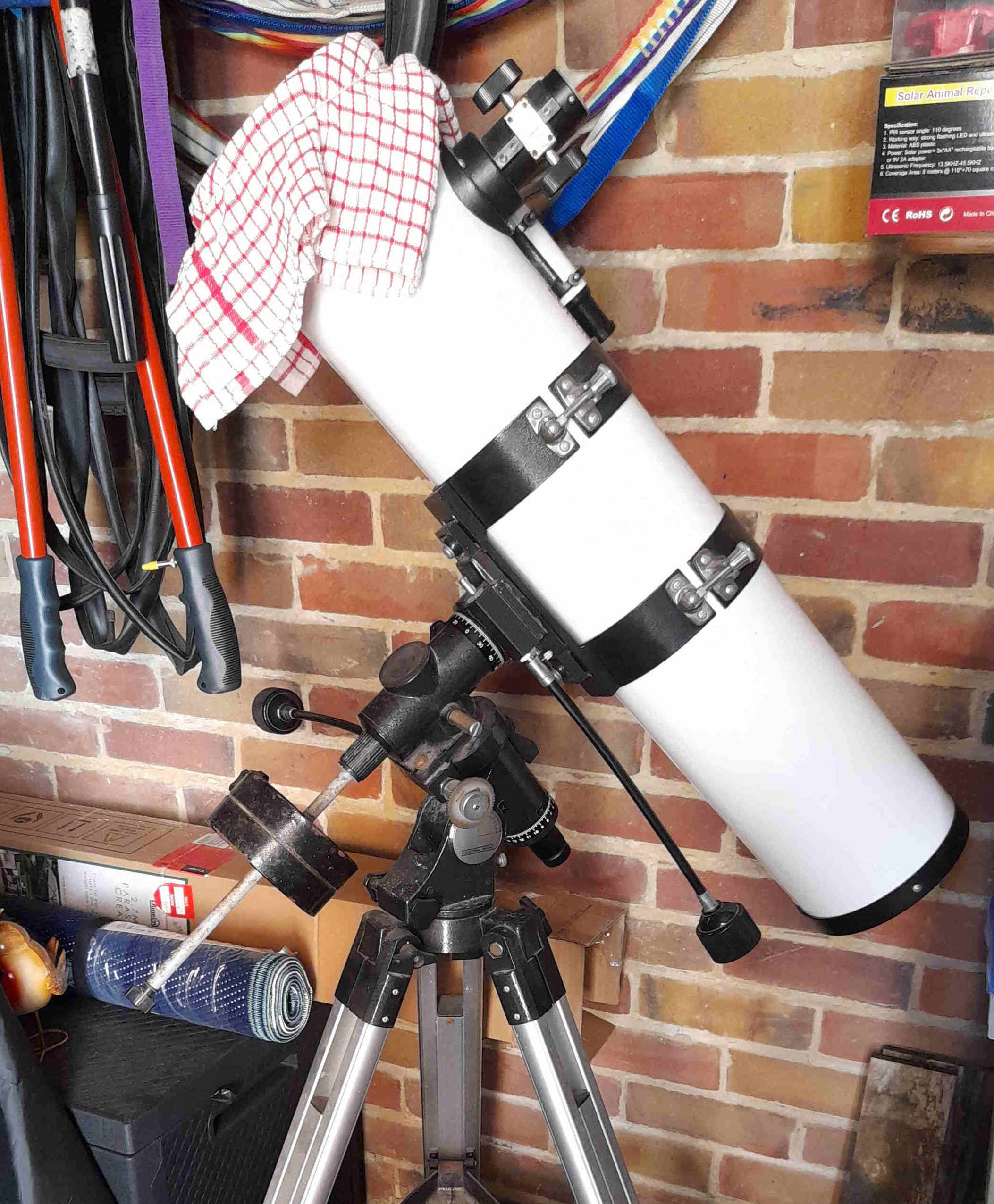
The tube has a focal length of 750mm, making it reasonably “fast” at f5. There was a motor drive on the RA axis, but this has now failed and I cannot get any spares. The telescope was originally supplied without a centre-spot on the main mirror to aid collimation, but adding that myself was a fairly simple task. More annoyingly, the focusser is probably fitted 1-2 cm closer to the mirror than ideal, meaning that it has to be racked out an unusually long way to achieve focus.
Geology
I am slowly working on a guide to Pegwell Bay (Ramsgate, Kent). As well as being my local “beach”, Pegwell Bay is the ‘type location’ for the sub-eocene unconformity; a break in the geological record between the underlying chalk (dating from the Cretaceous Period, about 100 million years ago) and the overlying Thanet Beds (dating from about 70 million years ago). The unconformity itself is marked by a bed of unworn, green-coated flints (called the Bullhead Bed).
The first step to producing this guide was achieved in 2005 when my paper on the Geology of Pegwell bay was published in the Open University Geological Society Journal (Spring edition 2005, Volume 26(1)) – a copy of the paper can be found here: The Geology of Pegwell Bay.
When completed, the guide will discuss the origin and evolution of the structures present, as well as the wider historical and natural scientific background of the site.
Attached here is my small write up of a visit to the fossiliferous beach at Portishead.
 Lee J. Russell, Author
You must be logged in to post a comment.