Well, that’s a divisive question!
I enjoy all aspects of the Star Trek universe from The Original Series (TOS), The Next Generation (TNG), Deep Space Nine (DS9 – this features one of my favourite episodes of all time, from any series of any program – “Duet” from series 1), Enterprise, The Animated Series, Voyager. Today I’m wondering which film starring the original crew is the best.
I’m not very keen on the recent TOS movie reboots, so I’m excluding those… sorry guys! I’m also excluding Star Trek Generations (1994) because, although it features Kirk, it’s really an introduction for TNG to the movie franchise. So that leaves:
- Star Trek: The Motion Picture (1979)
- Star Trek II: The Wrath of Khan (1982)
- Star Trek III: The Search for Spock (1984)
- Star Trek IV: The Voyage Home (1986)
- Star Trek V: The Final Frontier (1989)
- Star Trek VI: The Undiscovered Country (1991)
Here come my votes, in reverse order…
 In 6th Place – Star Trek III: The Search for Spock. In my opinion this is simply a weakly plotted film.
The moment when Spock dies at the end of Star Trek II – The Wrath of Khan was a sublime moment; the actors and director took their time to let this emotional moment play out properly, and the grief of Kirk seeing his friend die was wonderfully acted by Shatner. Who can forget their closing lines in that scene? …
SPOCK: “Ship …out of danger?”
KIRK: “Yes.”
SPOCK: “Don’t grieve, Admiral. It is logical. The needs of the many …outweigh…”
KIRK: “…the needs of the few.”
SPOCK: “Or the one. I never took the Kobayashi Maru test …until now. Wha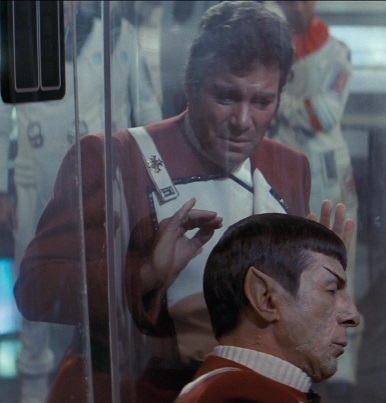 t do you think of my solution?”
KIRK: “Spock!”
Spock – falls to his knees, raises his hand on the glass separating him from Kirk.
SPOCK: “I have been …and always shall be …your friend. …Live long …and prosper.”
Spock – turns, sits and dies.
KIRK: “No!” <softly>
It seems to me that the intention here was to finish with just 2 films made. They would have been great films, ending on a great movie moment….
And then for some reason the movie franchise continued with Star Trek III. In this film Spock’s body is luckily/almost magically reincarnated by the effect of the Genesis weapon used by Khan at the end of Star Trek II. Fortunately McCoy i s also carrying Spock’s “katra” (soul?) from the end of Star Trek II. Now all Kirk has to do is steal the enterprise from Space Dock, travel to the Genesis world, pick up Spock’s body, take him to Vulcan and get his soul reunited with his body! Simple, eh?
Come on, that is a beginner-level plot for resurrecting the series… making for a pretty dull interlude in the Trek universe.
In  5th Place – Star Trek IV: The Voyage Home. Star Trek IV is the necessary step to get the crew back to Earth so that their adventures can continue. The tension of ‘will they be arrested for stealing the Enterprise’ feels shallow and much of the grand Space Opera that Trek is renowned for is instead replaced with what feels like an overly-long comedy sequence back in Earth’s recent history. What? Sorry? What’s happening there?
The plot is that the crew are returning home when a huge, mysterious cylindrical spacecraft arrives at Earth and starts beaming a message into the oceans for the whales. The trouble is that whales are now extinct in t his timeline. What’s the solution? Why, “time warp” of course! Now all the crew have to do is fly their stolen Klingon ship very fast and pass very close to the Sun, which apparently means they can then travel back in time, recover some whales (and simultaneously save them from being hunted), time warp them back to the ‘present day’, drop the whales into the ocean and let them talk to the cylindrical probe. All’s well that ends well: Kirk is forgiven, sort of demoted to Captain, and given command of the Enterprise NCC-1701-A.
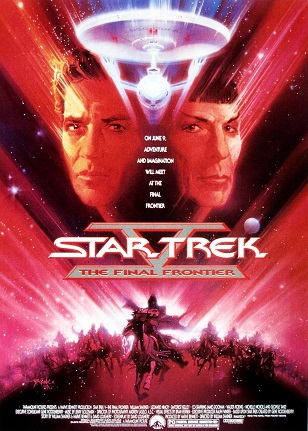 In 4th Place: Star Trek V: The Final Frontier (1989). Now the choosing is getting harder. This is a good film but over-shadowed by the Top 3.
After some (under-believable) male bonding between Kirk, McCoy and Spock in Yosemite National Park, the crew set off for Nimbus III in their new Enterprise, NCC-1701-A, in order to rescue the human, Klingon, and Romulan ambassadors who have been taken hostage.
 When they arrive, the crew discover that Spock’s renegade half-brother, Sybok, has used the ambassadors as bait to lure a starship to Nimbus III. Sybok has embraced his emotions and learnt how to use a mind-meld technique to heal a person’s mental pains. Sybok captures the Enterprise, with only Kirk and Spock resisting him. He then takes them to what is presumed to be an impenetrable barrier at the center of the galaxy, beyond which lies a mythical planet called “Sha Ka Ree”.
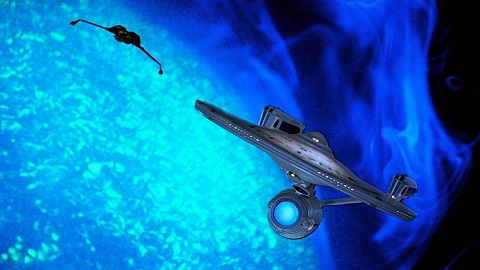 Sybok manages to penetrate the barrier (of course) and they find a single blue planet. He travels down to the surface with Kirk, Spock, and McCoy, where he expects to find God. When an entity eventually appears it wants to take control of the Enterprise. Kirk is attacked by it when he asks “What does God need with a starship?”, and Sybok comes to realise that this entity cannot be God. He mind-melds with the entity, allowing the others to escape.
There is also a small sub-plot involving another Klingon starship, but that adds little to the film, in my opinion.
Now we reach the Top 3!
 In 3rd Place: Star Trek VI: The Undiscovered Country. This is a good film and I have often enjoyed re-watching it. The film begins with the destruction of the Klingon moon called Praxis, their main source of energy. Without Praxis the Klingon Empire can’t continue in its current state for more than about fifty years. The Klingons don’t have the resources to both solve their energy problems and remain hostile towards the United Federation of Planets, so they have started to sue for peace.
Before the Klingons revert to a more militaristic solution, and probably all die fighting, Starfleet sends Kirk to meet with the Klingon Chancellor, Gorkon, and escort him to negotiations on Earth.  After their rendezvous, the humans and Klingons share a very tense (sometimes funny) dinner on board the Enterprise. Later that night the Enterprise appears to fire a pair of photon torpedoes at the Klingon ship, disabling its artificial gravity and enabling two figures in Starfleet spacesuits and gravity boots to beam aboard and grievously wound Gorkon.
In order to avoid conflict between their 2 ships, Kirk surrenders to the Klingons. He and McCoy beam aboard and McCoy unsuccessfully attempts to save Gorkon’s life. When the chancellor dies, Kirk and McCoy are found guilty and sentenced to life imprisonment at a frozen Klingon prison called “Rura Penthe”.
While Gorkon’s daughter, Azetbur, continues diplomatic negotiations, Kirk and McCoy eventually escape from the prison with the help of a shapeshifting alien called ‘Martia’. They evade a double-cross and are beamed up to the Enterprise by Spock.
A race is now on to get to at Camp Khitomer, where the latest Peace Conference is being held. Spock has learnt that some Sarfleet officers are afraid of the changes that peace might bring and have plotted to sabotage the peace talks. He also discovers that it was a cloaked Klingon starship that fired the torpedoes at Gorkon’s cruiser.
When they arrive above Camp Khitomer, the Enterprise (and Sulu’s Excelsior) have a skirmish with another Klingon warship, before they can eventually beam down and save the day.
The film closes with Starfleet ordering the Enterprise immediately back to Earth to be decommissioned. The crew decide to take their time travelling home and Kirk gives them the course of “Second Star to the right, and straight on til’ morning” (from Peter Pan).

A well-acted and exciting film, with good special effects and an excellent plot… which is beaten by the runner-up in this review of the best ‘Original Crew’ Star Trek movie by…
 In 2nd Place: Star Trek II: The Wrath of Khan. Of course some of the special effects in this film can’t match the quality of those found in the later films, but that misses the point. This film brings back one of Kirk’s old enemies from the original TV series, Khan Noonien Singh, wonderfully played by Ricardo Montalban in both that series 1 episode “Space Seed” and this film.
Khan is a genetically-engineered uber-human from the late 20th-century Eugenics Wars. His belief in his own abilities, both physical and mental, is total: he believes he is the superior man. In the TOS episode Khan tries to steal the Enterprise from Kirk. He very nearly succeeds and Kirk eventually lea ves him with his crew on Ceti Alpha V, a dangerous but habitable world.
Kirk believes that is end of the story with Khan. However, when the USS Reliant visits the Ceti Alpha system, Captain Terrell and Commander Pavel Chekov learn that they have visited Ceti Alpha V, not Ceti Alpha VI as they thought. They are captured by Khan who then takes control of their minds using some Ceti eels that wrap around their cerebral cortex, leaving them extremely susceptible to outside suggestion.
Khan captures the Reliant and a memorable battle follows when he ambushes the Enterprise, inflicting massive damage. Once the Enterprise is ‘dead in the water’ Khan reveals himself to Kirk. Khan says he will spare the crew of the Enterprise if Kirk beams aboard with data about the Genesis device. Kirk hatches a quick plan to send an override code in their data transmission about Genesis which will lower Reliant’s shields. This hasty plan works and the Enterprise is able to fire back, causing Khan to withdraw.
A small sub-plot then follows where we learn more about the Genesis device while the Enterprise is repaired and Khan steals the Genesis device.
 We then come to the final action scenes in the Battle of Mutara Nebula, where Khan’s inexperience in space battles enables Kirk to disable the Reliant. In his final act of revenge, Khan activates the Genesis device and the Enterprise barely escapes in time. Of course this is also the moment that Spock dies, as we saw earlier, making for a downbeat ending to an otherwise exciting action flic.
And now we’ve reached the Top Spot, and my vote for the “Best Star Trek Movie Starring the Original Crew” goes to… Star Trek: The Motion Picture!
 Part of me can’t believe that I’ve voted this way for the Top Spot. When I first saw “The Motion Picture” I mentally dubbed it as “Star Trek: The SLOW MOTION Picture”. It is a film that seems to take forever to get anywhere and spends much too long dwelling on very similar shots (especially the journey into V’Ger). However, over the years I have come to appreciate the time that is spent on these scenes. We are now very used to fast-paced films, driven by action and not dialogue, but the pace of this film reminds us that sometimes extraordinary things take time to work out.
In this film a massive energy cloud is detected moving toward Earth that is destroying everything in its path. The fear is that if it reaches Earth it will destroy that planet as well. The only starship in intercept range is the Enterprise-refit, and Admiral Kirk arranges to take command of it from Captain Decker. There is some obvious tension between Kirk and Decker, but the latter executes his roles of Science and First Officer well. Decker saves the ship when improperly calibrated engines nearly destroy it. Spock arrives a little later, having failed a V ulcan ritual to purge all of his emotions: he takes on the role of Science Officer, helps to fix the engines and explains that he has felt a consciousness emanating from the cloud.
When the Enterprise intercepts the energy cloud a probe appears on the bridge that abducts the navigator, Ilia, a former girlfriend of Decker’s. Ilia is later returned as a robotic probe, sent by V’Ger to study the crew. When Spock eventually takes a spacewalk further into V’Ger he attempts a mind meld and discovers that V’Ger is a living machine.
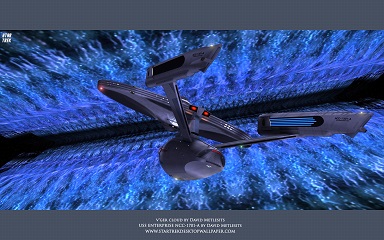 When the Enterprise reaches the centre of the energy cloud they discover that V’Ger is built around an Earth probe called Voyager 6, which had been believed lost in a black hole. Voyager 6 was repaired and upgraded by an alien race of living machines which interpreted its programming as instructions to “learn all that can be learned and return that information to its creator”.
[the image here is “V’Ger Cloud” by David Metlesits from startrekdesktopwallpaper.com]
By the time it had returned to Earth, V’Ger had gathered so much knowledge that it had become conscious. In the closing scenes of the film Decker and the Ilia merge, allowing V’Ger to convey its information to the Creator in person.
For me, the opening scenes of this film where Kirk sees the refit-Enterprise for the first time, when she leaves Space Dock, the Klingons’ attack on V’Ger, and the Enterprise’ slow progress into the energy cloud are wonderfully timeless moments, conveying the grand scale of everything that Star Trek means in its quest “to boldly go where no one has gone before”.
Fair Use Notice: The pictures used in this article have been taken from a number of internet sources and are included as ‘fair use’ of the images for the purposes of criticism, comment, teaching. No copyright is claimed and this content is shared for study, research and educational purposes. The images and other content on this page are offered publically and without profit, to the public users of the internet for comment and non-profit educational and informational purposes. Star Trek is copyright Paramount Pictures.

 Lotz has a simple and crisp style of writing that I found easy to engage with. The story is well-paced and I often found myself turning the page at the end of a chapter to see what would happen next. Her writing reminded me of that everyday-yet-out-of-kilter style found in early Stephen King novels, while the plot line felt quite Ballardian with ‘High Rise’ overtones.
 In the world of Dr Who, there are fixed points in Space-Time where events have such deep effects on the timeline of the Universe that they must not be altered, for fear of damaging reality itself. In our real-world lives I believe there are similar events that become fixed anchors in our personal timelines; these are the events that shape our lives and help to define who we are. On 2nd January 1978 one of those moments happened for me.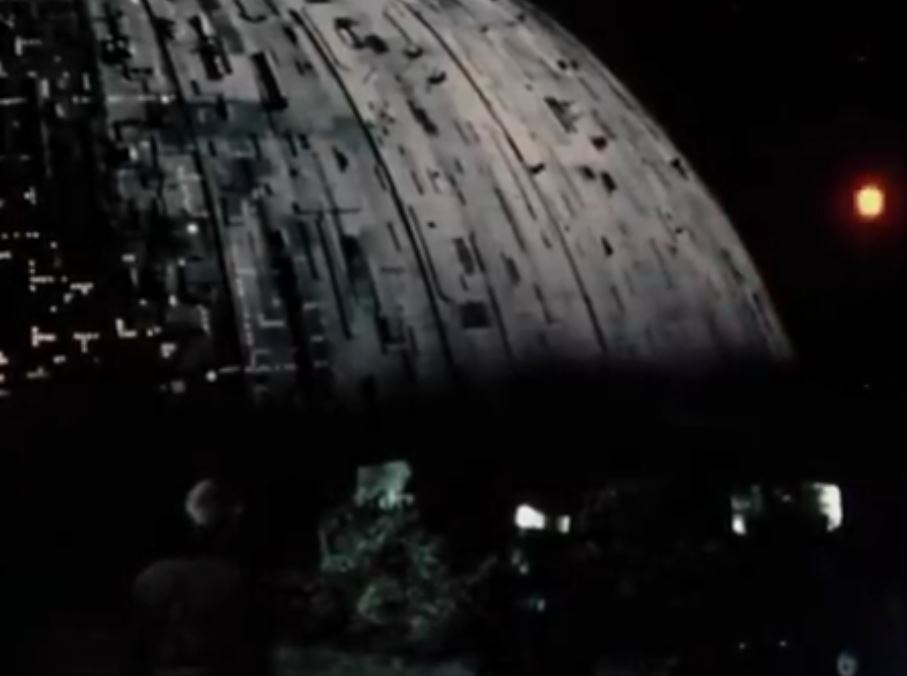
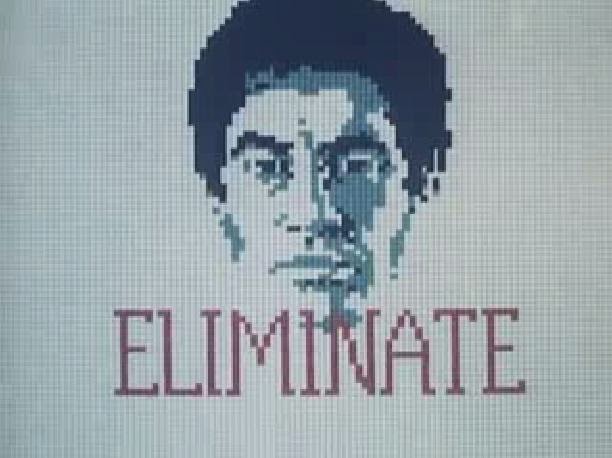
 Blake’s 7”
 1977 had just seen Tandy release the TRS-80 Micro Computer System, a desktop microcomputer with a QWERTY keyboard, a 64-character per line monitor, the new Zilog Z80 processor, 4 KB of RAM and an implementation of the BASIC programming language. Costing the equivalent of about US$2500, it was a forerunner of what was coming. In the same year Apple demonstrated the Apple II, offering colour graphics and an audio cassette drive for storage. Computer technology was NEW, and it was exciting to think that we could be programming machines to do our bidding! Little did we appreciate the profound impact they would have on employment though… but that’s another story.
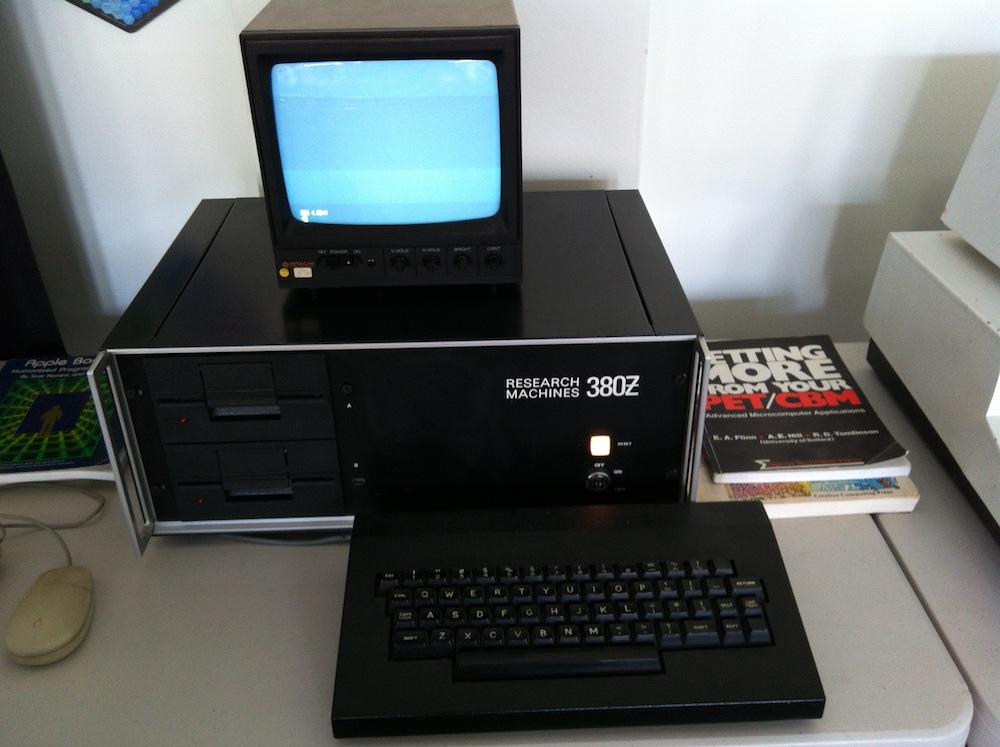 By the early 1980s I was learning to program using Z80-based, RML-380Z computers built by ‘Research Machines’ in Oxford. These machines are now rare to find in good working order and sell for around £500 – £1,000 depending on their condition. The ones in my school had 56k of RAM, 5¼” or 8″ floppy disk drives and high-resolution graphics boards. I learnt to program in Assembly Language, BASIC, COBOL, some Pascal and Fortran, and those skills have kept me in good stead (and steady employment) for the next 30+ years, so some good came from it all!
 This is the surveillance culture that Terry Nation tapped into during the opening scenes of Episode 1 – who can forget those black cameras pivoting to watch the Dome City’s inhabitants as they moved around?
 I think it happened a bit like eating a salami, one slice at a time. Today’s reality is much worse than Terry Nation predicted with B7 and just an ideological step away from the Far Right state predicted by Orwell in ‘1984’ – Travis would love this modern world, finding and eliminating Blake would have been simple.
 Public employees were walking out leaving food and fuel undelivered, rubbish uncollected, and bodies unburied. What government can survive when it can’t feed its people or bury the dead? Callaghan’s didn’t, and on 3rd May 1979 he was ousted in the polls by Margaret Thatcher.
 Thatcher was a completely different kind of political animal. She exuded a confident, indomitable spirit and would not accept weakness anywhere, in herself, her cabinet or the wider Central/Local government. Dubbed “the Iron Lady” by the media, Thatcher broke the Trade Unions’ hold over the country and re-made the UK economy with a new approach that was dubbed ‘Thatcherism’. Out went Keynesianism, belief in the welfare state ‘looking after’ the population, deeply nationalised industry and close regulation of the British economy. In came a belief that through entrepreneurialism people could quiet ably look after themselves, that success came to those who worked for it, monetarism with a priority on controlling inflation over unemployment, social conservatism over liberalism. It was a time of great opportunity for those who could reach higher into the new technological age and look after themselves. It was also a time of great suffering for those who couldn’t, and their scars still run deep in UK society today. How much of the character of Servalan was influenced by Thatcher and Thatcherism, I wonder?
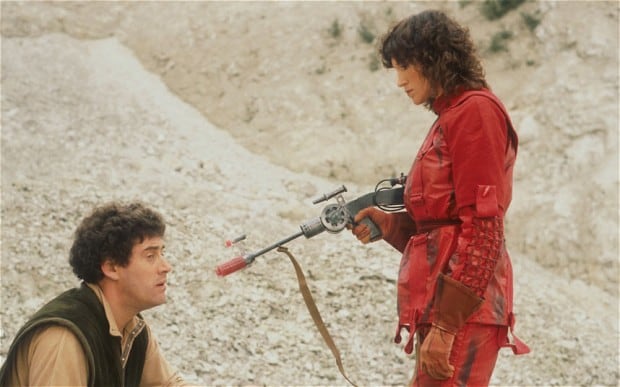 Cally – a telepath from the planet Auron. She had been helping freedom fighters on the planet Saurian Major resist the Federation. When the Federation killed all the rebels by releasing “poison from the sky”, she decided to stay and fight, to “destroy until I am destroyed”. Cally is perhaps a purer expression of the resistance that we understand Blake was leading. Not a convicted criminal, she is initially almost fanatical about fighting the Federation before developing more into the ‘moral conscience’ of Blake’s team. In her earlier episodes she perhaps expresses the solid determination that many people wished they had to stand up against the changing world.
 I just posted a new vlog about ‘Evil Eye – A Lissa Blackwood Thriller’ on my YouTube channel at
  I’m really excited to announce that the first draft of “Evil Eye – A Lissa Blackwood Thriller”, the opening book in my new series of post-Brexit Conspiracy Thrillers, has been completed.

 –
–


 Lee J. Russell, Author
You must be logged in to post a comment.