“The Culture” is a series of nine novels and one short story collection written by Iain M. Banks:
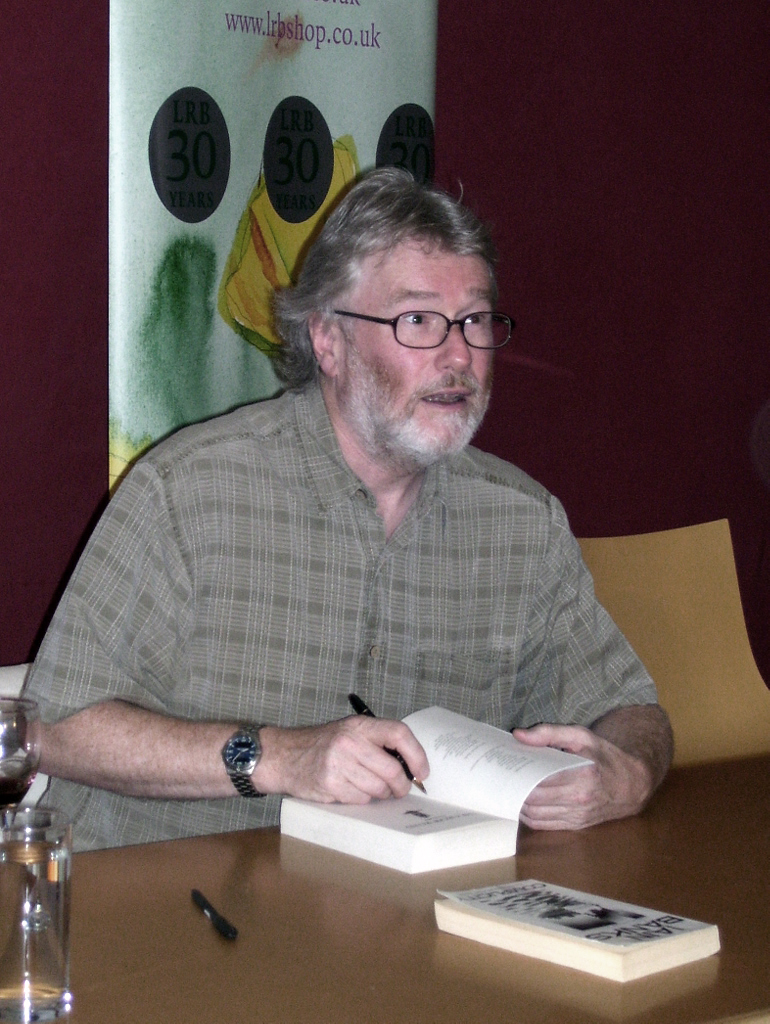
By TimDuncan – Own work, CC BY-SA 3.0, https://commons.wikimedia.org/w/index.php?curid=7599707
Consider Phlebas (1987)
The Player of Games (1988)
Use of Weapons (1990)
The State of the Art (1989)
Excession (1996)
Inversions (1998)
Look to Windward (2000)
Matter (2008)
Surface Detail (2010)
The Hydrogen Sonata (2012)
“The Culture” is the name given by Banks to an advanced interstellar civilisation that forms the backdrop to his series of ‘Culture novels’. It is a vast, loosely organised society composed of humans, alien species, and super-intelligent artificial intelligences known as ‘Minds’.
The Culture is a post-scarcity civilisation where technology has advanced to such a degree that material needs are effortlessly met. There is no money, and no need for money. There is no enforced hierarchy, and little need for formal laws. Most work is unnecessary, and individuals are free to pursue whatever interests them.
Disease is eliminated and even severe bodily damage need not be fatal. Biological individuals have modified bodies enabling them to probably ‘gland’ all the hormones and medicines they would need to extend their lifespan indefinitely. They can modify their physical forms and minds at will.
Social governance is largely handled by the Minds, whose intelligence and perspective exceeds that of biological beings. The Minds manage resources, coordinate society, and often act as moral agents.
The Culture combines internal equality with external independence. According to Vox 1, Banks described it as “… socialism within, anarchy without…” in an 1994 Usenet post.
The result is a civilisation that appears utopian.
Yet the novels rarely focus on life inside this utopia. Instead, they explore The Culture’s interactions with other civilisations, frequently less advanced or less ‘ethical’. These interactions are often handled by Culture organisations such as ‘Contact’ and ‘Special Circumstances’ (SC), and raise difficult moral questions. Should a powerful, benevolent society intervene in the development of others? Can utopia coexist with manipulation, espionage, and war? It is in these tensions that the Culture series finds its narrative energy.
Major Themes in the Culture Novels:
1. Non-Interference vs the Moral Imperative to Intervene.
Key books: Consider Phlebas, The Player of Games, Use of Weapons, Look to Windward.
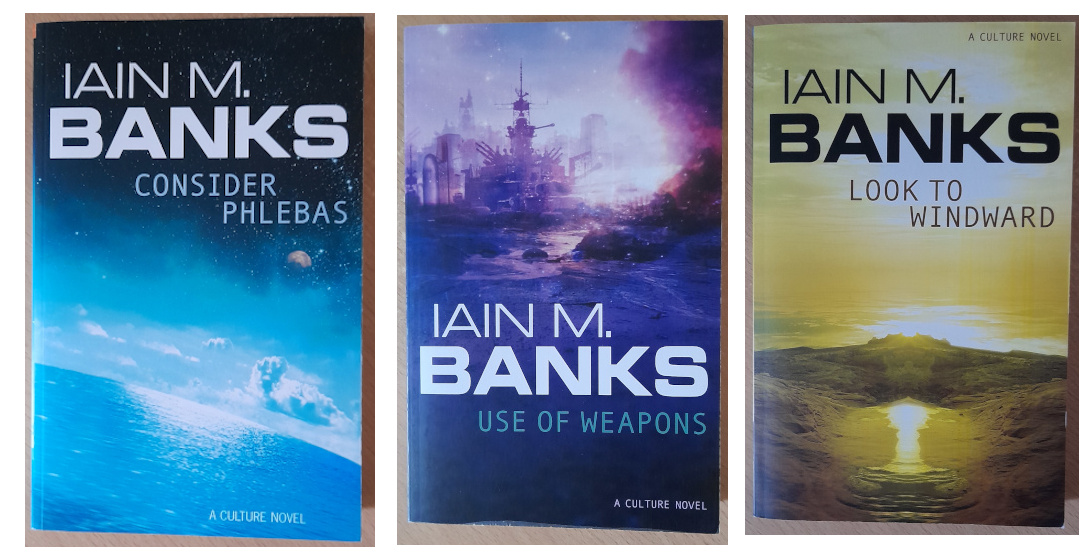
One of the most persistent themes in the series is whether a powerful civilisation has the right, or indeed the obligation, to intervene in the development of others. Non-interference may result in significant social harms being incurred in the other society. But interference can result in mistakes and unintended consequences. The Culture may be “right,” but it is rarely innocent.
For example, in The Player of Games, the protagonist Gurgeh is effectively forced (by SC) to interfere in the development of the Empire of Azad by being invited to take part in their national game, also called “Azad”. Azad (the game) is brutally used to determine the development and progression of the Empire’s entire social hierarchy. The Culture’s involvement is subtle but deliberate, seeking to destabilise a system it considers unjust. The novel explores whether such intervention is benevolent or imperialistic.
Use of Weapons pushes this further, following an agent used by The Culture to influence other societies, often with the use of extreme violence. The story reveals the psychological cost of being a tool of “good intentions,” suggesting that even ethical ends can demand morally troubling means.
Meanwhile, Look to Windward reflects on the aftermath of interventions through the lens of The Culture’s involvement with the Chelgrians. It seems that, during a period of Chelgrian civil conflict, SC attempted to steer events away from mass violence and authoritarian consolidation. However, these interventions were not clean. They became entangled with Chelgrian notions of honour, betrayal, and legitimacy, meaning that even well-intentioned nudges were often interpreted as profound moral violations or acts of subversion. Look to Windward examines guilt, unintended consequences, and whether The Culture’s actions truly improved the galaxy.
2. Utopia and Its Discontents.
Key books: The Player of Games, Excession, The Hydrogen Sonata.
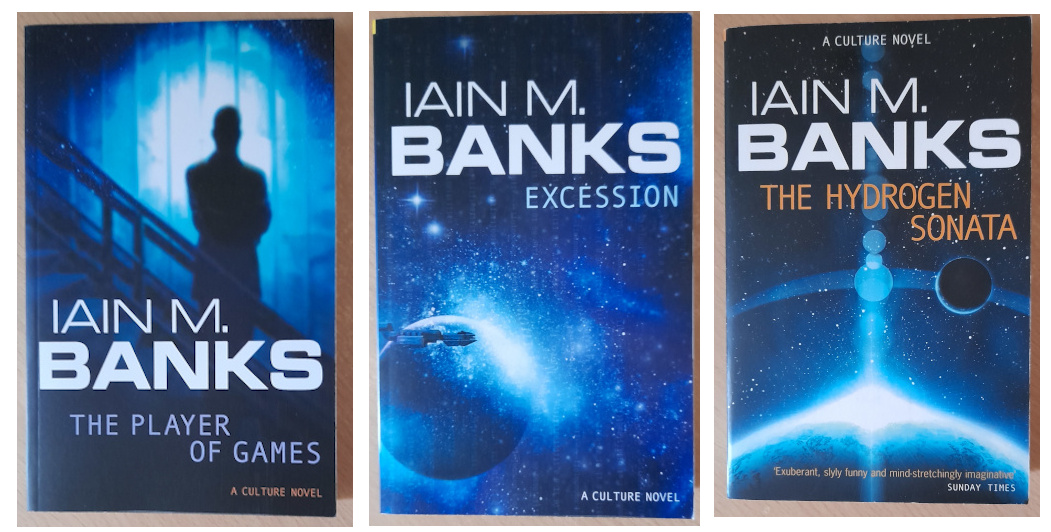
Banks repeatedly questions whether The Culture is an ideal society. For example, in The Player of Games, Gurgeh initially finds Culture life stagnant and purposeless. Without scarcity or struggle, meaning in life has become self-generated, and he is largely lacking purpose. He seems to only become truly alive, meeting his full potential, when facing life or death challenges while playing Azad. So is hardship necessary for fulfilment?
Excession shifts our focus to the Minds, which have become so absorbed by the appearance of a mysterious and apparently impossible object in deep space (labelled as the ‘Excession’) that they effectively split into factions. Some adopt cautious, containment-focused strategies. Other engage in more secretive, opportunistic planning, including manipulation of external civilisations like the Affront. Dangerous external actions could be taken without full consensus. Ultimately, The Culture’s architecture is resilient enough that these intense disagreements don’t become an existential threat. However, we do come to see how the Minds operate as a sub-layer of powerful intelligences with their own agendas.
In The Hydrogen Sonata, the theme expands to look at civilisations choosing to “Sublime” (leave the physical universe). Just before the Gzilt are about to complete their Sublimation, troubling questions emerge about the authenticity of their foundational religious text, called the “Book of Truth”. It is possible that their decision to ascend is based on a long-standing deception. This uncertainty triggers political tension, covert investigations, and last-minute manoeuvring across multiple factions, including agents linked to The Culture. The novel questions whether even a utopia is ultimately a temporary stage, rather than an endpoint.
Banks himself acknowledged this tension, noting that The Culture is “… my ideal utopia…”, but one that still allows for storytelling through its interactions with less perfect societies 2.
3. The Role of Artificial Intelligence.
Key books: Excession, Surface Detail, Look to Windward.
The Culture’s reliance on AI is central to its structure and one of its most provocative ideas. Artificial intelligence is not just a supporting technology. It constitutes the governing class of the Culture civilisation, embodied primarily in the vast intellects known as ‘Minds’. These Minds operate on cognitive scales far beyond biological ability, simultaneously managing logistics, strategy, ethics, and long-term planning across entire star systems. They are not merely administrators but active moral agents, capable of debate, disagreement, and even political factionalism, as seen most clearly in ‘Excession’. Coordination of The Culture depends on these super-intelligences quietly steering outcomes, often while allowing biological citizens to believe they live in a largely self-directed society.
Smaller autonomous AIs take physical form as drones. These mobile, often humanoid-scale, machines serve as companions, assistants, and frequently as SC operatives. In books such as ‘The Player of Games’ and ‘Use of Weapons’, drones act as guides, spies, negotiators, and sometimes manipulators, embodying The Culture’s willingness to delegate moral and operational authority to non-biological entities. Drones are consistently portrayed as fully conscious entities with humour, preferences, and ethical reasoning, and are often more emotionally stable than the humans they accompany.
‘Surface Detail’, meanwhile, raises ethical questions about suffering in virtual realities and simulated afterlives. The Culture opposes the existence of “hells” in virtual space, leading to conflict with societies that maintain them.
Banks suggested that such reliance on machines might be both necessary and troubling, noting that while AI may be inevitable, “… humanity can find its own salvation. It doesn’t necessarily have to rely on machines. It’ll be a bit sad if we did, if it’s our only real form of progress.” 3
4. War, Power, and Justification.
Key books: Consider Phlebas, Look to Windward.
The Culture is often peaceful, but not pacifist. It possesses overwhelming military power, and uses it when necessary. Consider Phlebas, set during the Idiran War, presents conflict from the perspective of an enemy agent. This inversion challenges readers to see The Culture not just as obvious heroes, but as one side in a complex moral struggle. Look to Windward revisits this war decades later, focusing on trauma and memory. It questions whether even a justified war can avoid moral compromise.
Banks’ work suggests that power does not eliminate ethical dilemmas, it intensifies them.
Concluding Thoughts.
The Culture series is one of the most ambitious achievements in modern science fiction. It shifts the genre’s focus from survival to responsibility. It moves SF from asking how to build a better world, to how we should behave within it.
It does not offer easy answers to questions around conflicts, intervention, power and identity. Instead, it presents a vision of the future that is both hopeful and unsettling: a civilisation that has solved most material problems, yet continues to grapple with moral ones.
Perhaps the final, concluding thought is that that progress does not eliminate ethical complexity, it simply moves it to a higher level.
Pictures of covers taken from personal copies of the books and reproduced here as fair dealing for the purposes of reviewing the books – no copyright is claimed here for those images, which remain the property of the copyright holders.
1 – https://www.vox.com/culture/413502/iain-banks-culture-series-elon-musk-jeff-bezos-mark-zuckerberg
2 – https://www.tumblr.com/notthedayjob/8914135987/interview-iain-m-banks-whats-in-an-m
3 – https://thedailyomnivore.net/2012/05/03/the-culture/
 Lee J. Russell, Author