This is a long article, intended to summarise and celebrate Isaac Asimov’s seminal science fiction (SF) series.
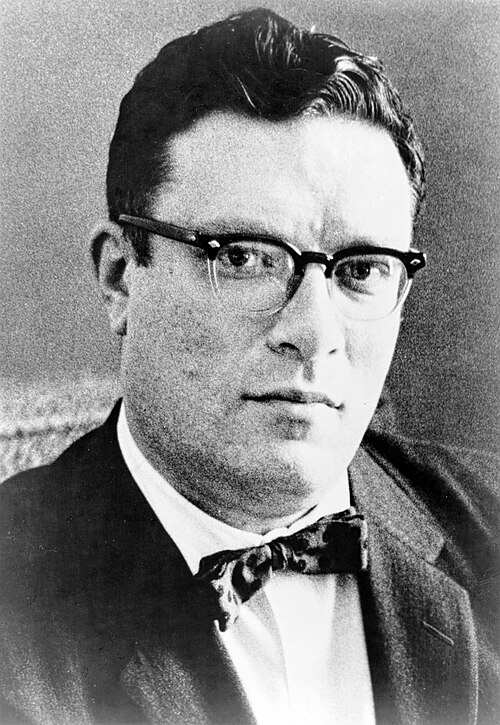
Public Domain via Wikipedia.com
Isaac Asimov was one of the most influential SF writers of the twentieth century. Born in Petrovichi, Russia, sometime between 4th October 1919 and 2nd January 1920, his family emigrated to the United States of America in 1923. I am not going to dwell here on his education and life in the USA, as that is well-documented elsewhere.
Asimov was a prolific writer in many areas of both fiction and non-fiction. He began writing SF in short story form in 1939, and then as novels from 1950. His main period of writing SF ended around 1957 with “The Naked Sun”, but then resumed in 1982 with “Foundation’s Edge” (one of the books we’ll look at here in a moment).
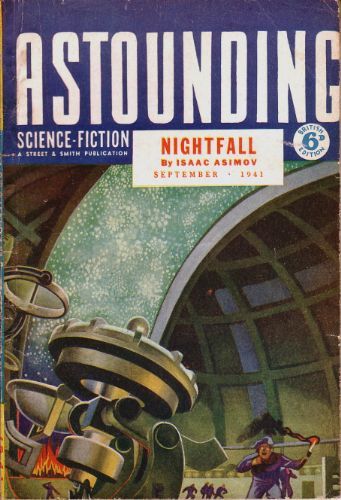
Only two years into writing sci-fi short stories, he wrote what I believe is his masterpiece of short fiction — “Nightfall”. That story has a rich physical and social scientific backdrop that keeps it as relevant today as it was eighty-four years ago (at the time of this article). He set a high bar for his future writing with that story, but then reached and surpassed it with the eight short stories that would later become the ‘Foundation Series’ between 1942 to 1950.
Gnome Press collated the Foundation stories into the novels we all love today between 1951 – 1953, as “Foundation”, “Foundation and Empire”, and “Second Foundation”. Even now, decades after reading these novels for the first time, the ideas of Hari Seldon and psychohistory still send shivers down my spine…
… so what is ‘The Foundation Series’ about? …
… and what makes it so loved, even now…
… when many other tales from the same period feel dated and tired?
Let’s start by looking at each story in turn, ordering them in their final sequence rather than publication order.
– fair use for non-commercial review
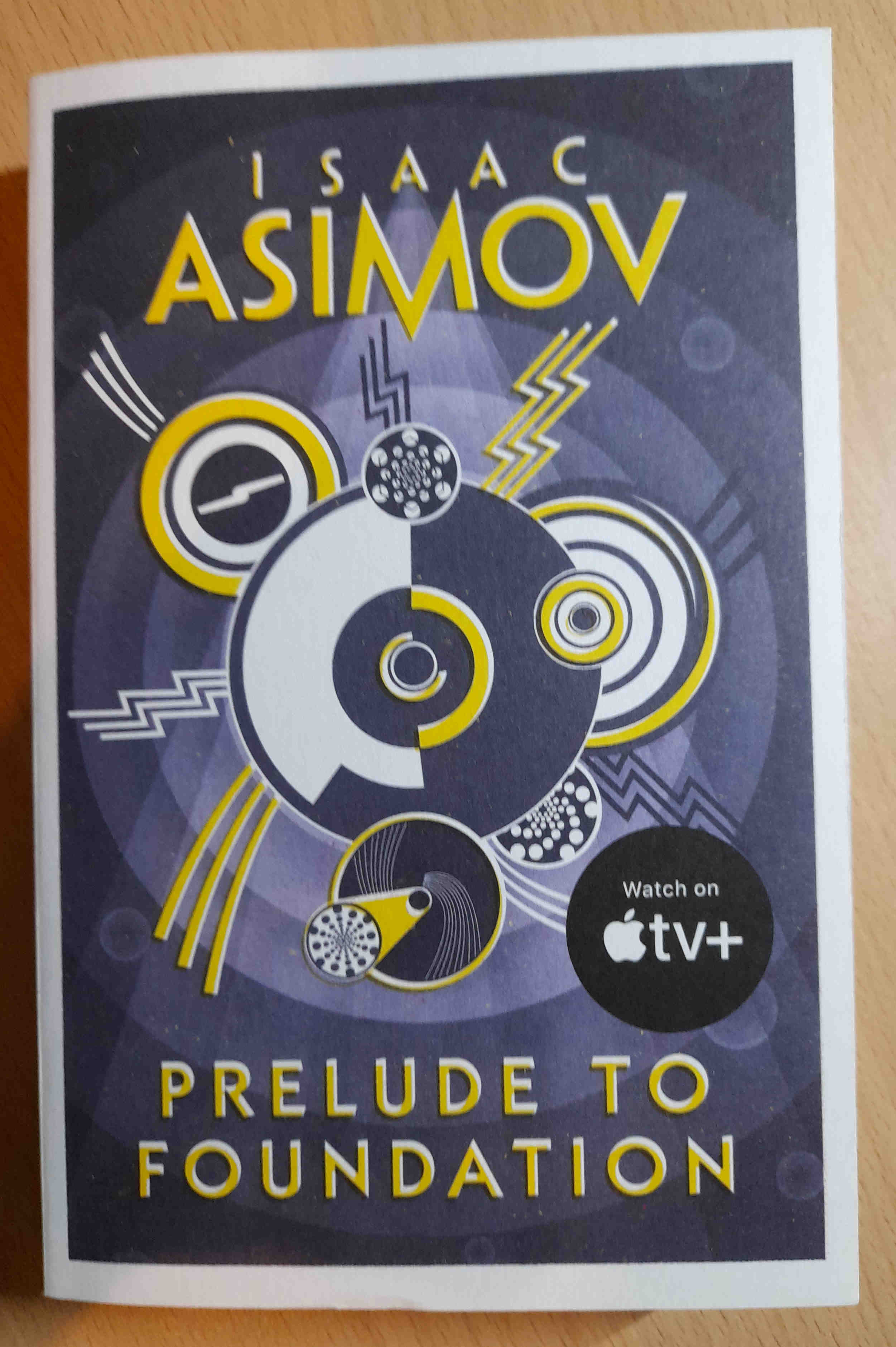
1. “Prelude to Foundation” (1988)
The novel, and indeed the series, opens on Trantor, capital of the Galactic Empire, a planet entirely covered by metal, totally urbanised, and home to over forty billion people. The Empire is at its height, spanning across millions of inhabited planets. Asimov introduces us to the arrival on Trantor of Hari Seldon, a provincial mathematician from Helicon, who presents a paper suggesting that the behaviour of large populations can be predicted statistically. The work is theoretical but has explosive political implications:
… if large populations can be predicted statistically…
then they might also be influenced and steered by whoever controls Seldon’s new mathematics.
The Emperor, Cleon I, initially sees an opportunity in Seldon’s work. He understands that if a mathematician were to assert that Cleon would have a long and happy reign, during a period of peace and prosperity for the Empire, that the general population would tend to believe it, and feeling assured about the future, would then tend to act on that belief — making for a self-fulfilling prophecy.
Seldon is pulled in to meet Cleon, who clearly hopes to manipulate him for his own purposes, but is then disappointed to learn that the mathematics of psychohistory are only a possibility, and not sufficiently developed to have any practical use. However, it might become practical in the future and fall into the hands of Cleon’s enemies, so Seldon is placed under close, covert surveillance.
This setup for the book, and the entire Foundation series, is detailed and realistic, yet Asimov pulls it off in just 18 pages.
Seldon then explores Trantor’s vast and diverse sectors, each of which is home to people with distinctive appearances and traits. Along the way, he encounters figures such as Dors Venabili, his enigmatic protector and future wife, and Raych Foss, a streetwise youth who will become his adopted son. And while the Empire appears stable on the surface, we start to see corruption, economic stratification, cultural fragmentation, stagnation, and political manoeuvring that are all suggesting otherwise. We also come to see how psychohistory will require a deep understanding of human behaviour, in addition to Seldon’s mathematics.
In what felt to me as an unnecessary plot twist, at the end of the book we are told that Cleon’s Chief of Staff, Eto Demerzel, is actually a robot called R. Daneel Olivaw, who has been working to find ways to ease, as much as possible, the effect of the decline of the Empire. Olivaw essentially talks Seldon into committing himself to the long, uncertain project of developing psychohistory, setting him on a path that will be intimately tied to the fate of the Empire.
– fair use for non-commercial review
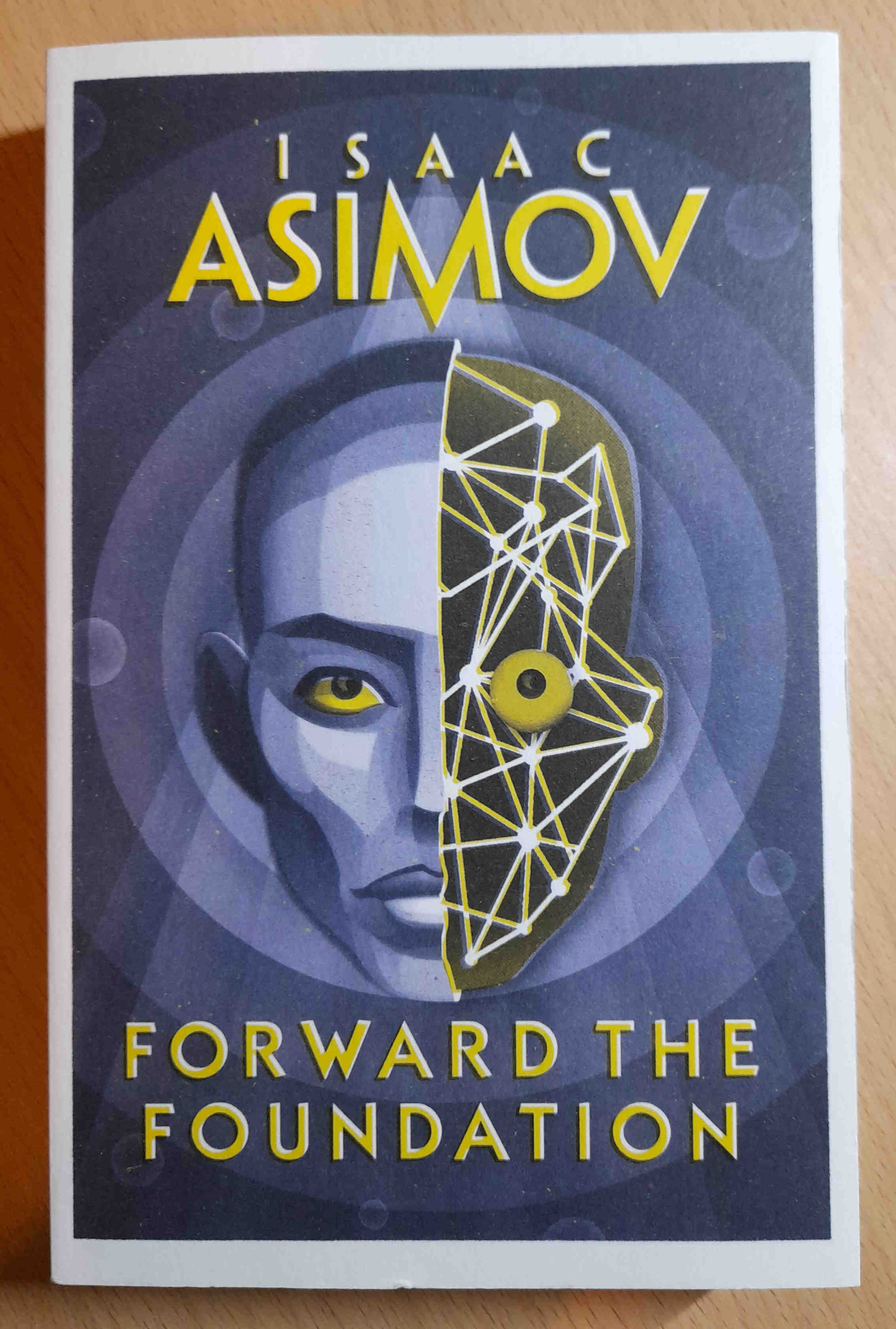
2. “Forward the Foundation” (1993)
The second book in the series follows Seldon’s later life as he develops psychohistory from theory into a workable, predictive science. Over decades, Seldon is slowly transformed from being a professional mathematician into an architect of galactic destiny, as his psychohistory advances through incremental breakthroughs. He becomes a reluctant public figure, increasingly enmeshed in Imperial bureaucracy.
Political pressure intensifies as Emperors rise and fall, while the court is rife with conspiracies. Psychohistory is feared, exploited, and suppressed depending on who holds power. Seldon has to downplay and conceal his work’s significance in order for it, and himself, to survive. He forms a small but crucial research group, laying the institutional groundwork for what will become the ‘Foundation’.
Seldon’s relationship with Dors Venabili deepens into marriage, though it is shadowed by secrecy. She is intensely protective of Seldon, sometimes unnervingly so, and her presence shields him from assassination attempts orchestrated by court rivals who fear psychohistory’s implications. Tragedy strikes when she is destroyed while protecting Seldon, revealing her own robotic nature.
Seldon is now getting old. The book ends with him completing the creation of the Seldon Plan, establishing two Foundations (one pursuing physical sciences, the other a new field of mental science), setting up the Seldon Vault, and accepting the inevitability of his death. His legacy unfolds in the next book in the series, Foundation.
– fair use for non-commercial review
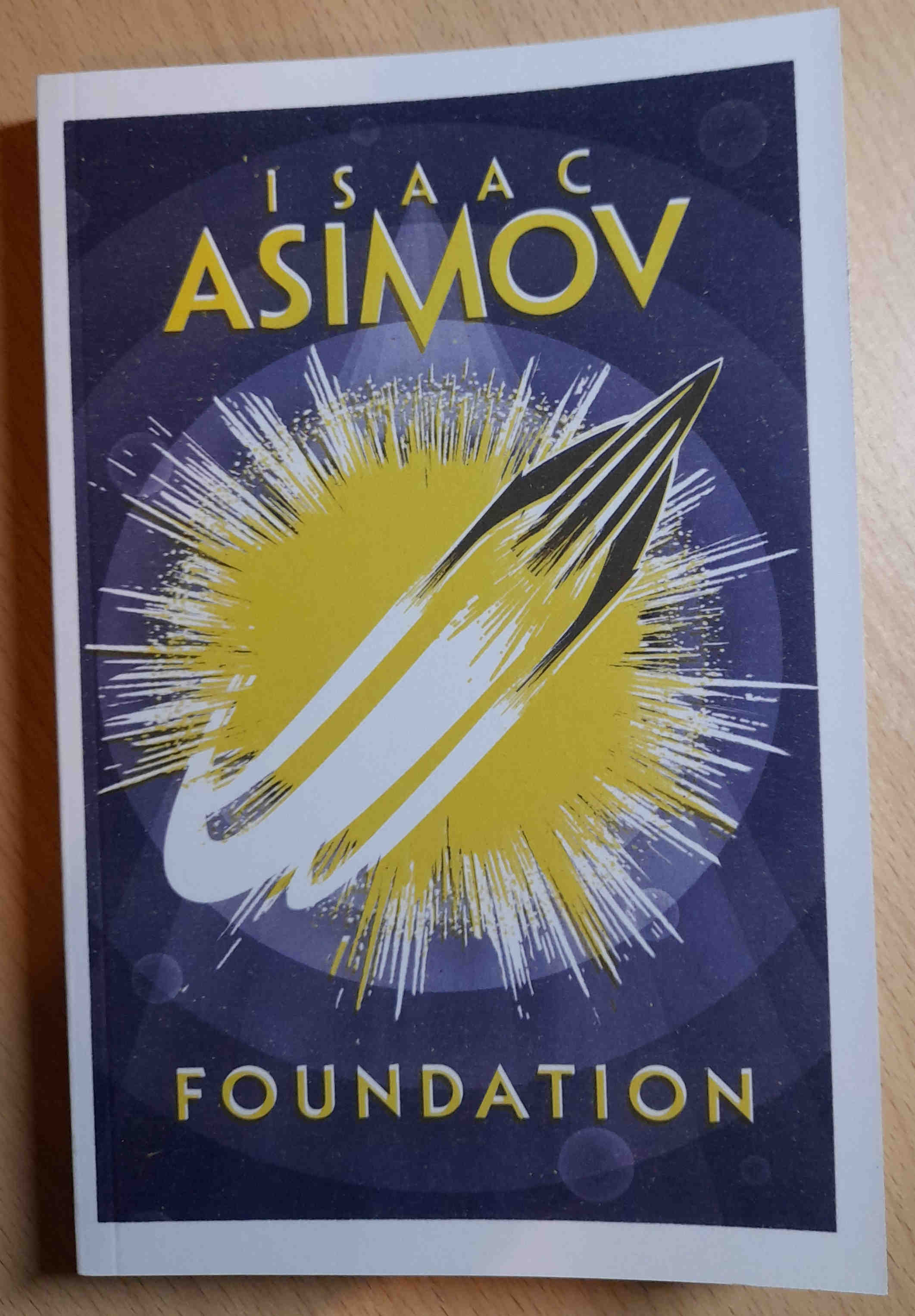
3. “Foundation” (1951)
We now reach Asimov’s 1942/1951 (depending on how you look at it) starting point for writing about Seldon and the Foundation.
Foundation explores the rise and fall of civilisations, emphasising large-scale historical forces over individual heroism. It shows how knowledge becomes power, first through religion and later through trade and economics. It presents history as being predictable at the population level, with psychohistory demonstrating that social and political trends can be guided if they are understood. Violence is consistently shown to be less effective than strategy, foresight, and control of resources.
The novel opens on Trantor, where Hari Seldon has now developed psychohistory into a functioning statistical science that can predict the future behaviour of large populations. Using psychohistory, Seldon has concluded that the Galactic Empire is destined to collapse, and that this collapse will be followed by 30,000 years of barbarism before civilisation recovers. His goal is not to prevent the collapse, which he considers inevitable, but to reduce the period of chaos to 1,000 years.
Seldon is tried by the Imperial authorities for spreading predictions that could undermine the Empire. He persuades them that his work is harmless by proposing the creation of an Encyclopedia Galactica, a comprehensive record of all human knowledge that is intended to preserve learning through the coming dark age. The scholars who will compile it are exiled to a distant and barren planet at the edge of the galaxy called ‘Terminus’. Unknown to most of them, this group — the Foundation —is a crucial element in Seldon’s plan.
Seldon dies shortly after the (first) Foundation has been established. Decades later, the scholars on Terminus are leading the Foundation. Focussed solely on producing the encyclopedia, they are unaware that their work was just a ploy to get the Foundation established, and intensely naive about the Powers emerging around them as the surrounding regions of the Empire fragment into independent kingdoms.
Terminus has no significant natural resources and no military force. Salvor Hardin, the city’s mayor, argues that they are facing real danger by neglecting the politics surrounding the newly emerging kingdoms. When one of them, the Anacreonians, threatens Terminus, a prerecorded holographic message from Hari Seldon appears in the Seldon Vault, revealing that the Foundation was never meant to finish the Encyclopedia, and confirming that this political crisis (the first Seldon Crisis) was anticipated.
Hardin guides the Foundation to survival by exploiting its superior scientific knowledge. As technological understanding decays elsewhere, the Foundation presents its technology as sacred, creating a religion that places its technicians in priestly roles. Neighbouring kingdoms become dependent on these “priests” to maintain advanced devices they no longer understand. This religious influence allows the Foundation to dominate without direct violence or military power. This use of influence is completely aligned with one of Hardin’s sayings:
“Violence is the last refuge of the incompetent.”
Over time, the use of this pseudo-religious authority becomes unstable. The Foundation then uses its technological expertise to produce valuable goods that other worlds cannot manufacture, shifting towards projecting power through economic influence. Independent traders become key agents of the Foundation’s expansion. They travel beyond Foundation-controlled space, spreading its technology and establishing economic dependence. While these traders increase the Foundation’s influence, they also gain personal wealth and power, creating tension between commercial interests and the central government on Terminus. The final section of the book focuses on Hober Mallow, a trader who becomes a political leader. This transition occurs during another Seldon Crisis, which again resolves in accordance with Seldon’s predictions.
The novel ends with the Foundation secure, expanding, and still moving along the path laid out by Seldon.
– fair use for non-commercial review
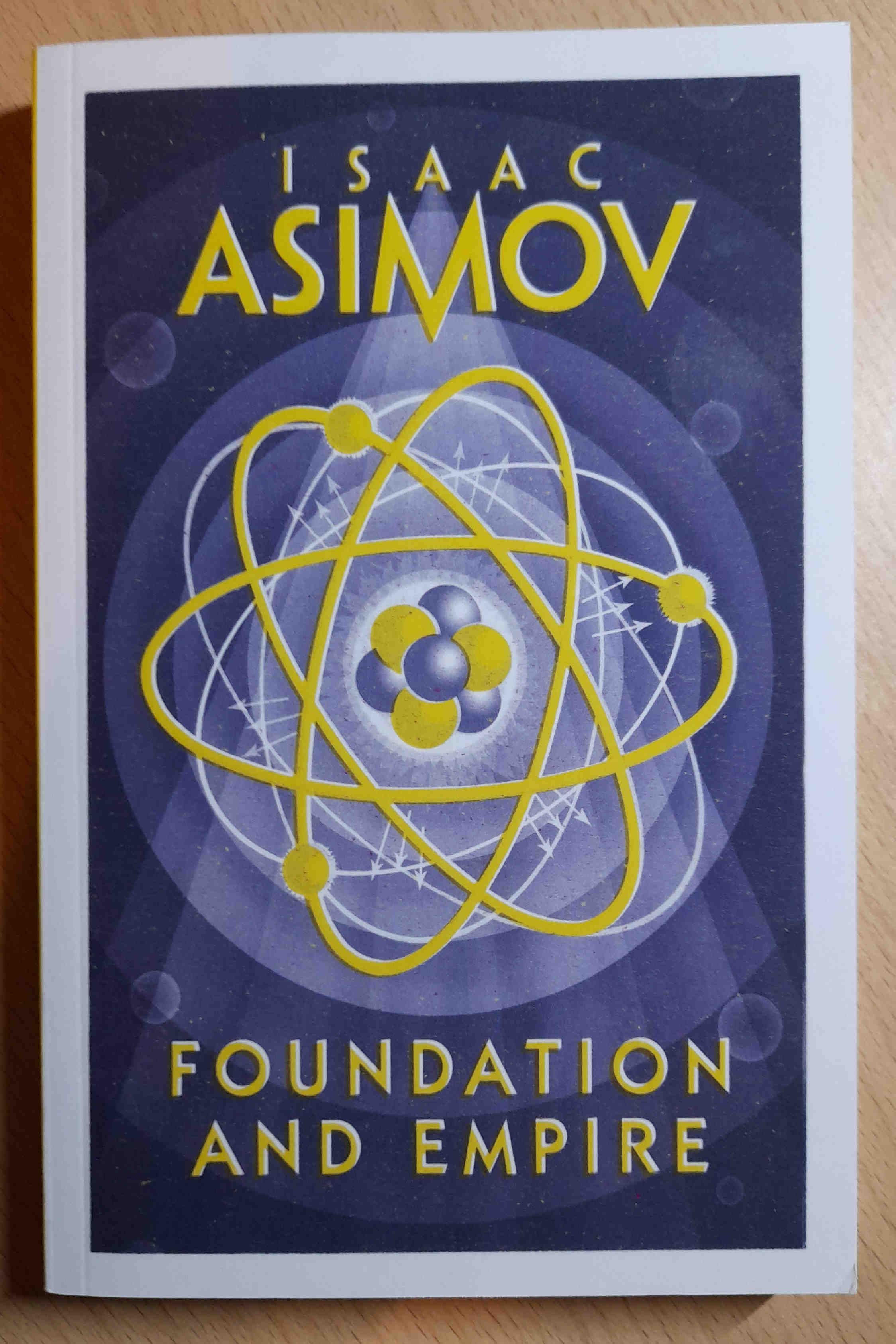
4. “Foundation and Empire” (1952)
Foundation and Empire examines the tension between historical determinism and individual agency. Two challenges to the Foundation are now shown that were not fully anticipated by the Seldon Plan.
The first challenge shows how institutional decay and political fear can defeat even rational self-interest, while the second shows the vulnerability of predictive systems when confronted with singular anomalies. Together, they challenge the assumption that history can be fully managed or forecast, even through scientific means like psychohistory.
The first challenge, entitled ‘The General’, is set during a period when the Galactic Empire is weakened but still intact. The Emperor, Cleon II, rules from Trantor, though the Empire suffers from political decay and internal distrust. The Foundation has grown economically and technologically, and is increasingly viewed as a potential rival.
Bel Riose, a highly competent and ambitious Imperial general, is tasked with investigating the Foundation and determining whether it poses a genuine threat. Unlike previous Imperial figures, Riose correctly understands that the Foundation’s strength lies in its technological superiority and organisational efficiency, rather than religion or bluff. He launches a military campaign and achieves a series of tactical successes against Foundation forces.
However, despite his progress, Riose’s campaign is undermined by the political climate in the Imperial Court. His growing reputation and effectiveness raise suspicions, and Cleon II becomes convinced that Riose’s success could lead to rebellion. Riose is recalled to Trantor, accused of treason, and executed, bringing the campaign to an end and leaving the Foundation intact without having directly defeated him.
The second challenge, entitled ‘The Mule’, takes place many years later, after the Foundation has expanded its influence and come to rely heavily on psychohistory as a guarantee of success. An unexpected, mysterious conqueror known as the Mule emerges, rapidly defeating both Foundation-controlled worlds and remnants of the Empire. His actions produce outcomes that do not align with Seldon’s predictions. It is eventually revealed that the Mule is a mutant with the ability to alter emotions, allowing him to impose loyalty, fear, or devotion on others. This unique ability enables him to control individuals and populations directly. Because psychohistory depends on predictable mass behavior and excludes the influence of singular individuals, the Mule represents an unforeseen disruption.
The appearance of the Mule raises the central question of whether any system can truly account for exceptional individuals.
As the Mule consolidates power, characters within the story search for the Second Foundation, a secret group that Hari Seldon is said to have established as a corrective force. The Mule himself attempts to locate it but is unsuccessful. The novel ends with the Mule in control of the galaxy, while the Second Foundation remains hidden, suggesting that future resistance may still be possible.
– fair use for non-commercial review
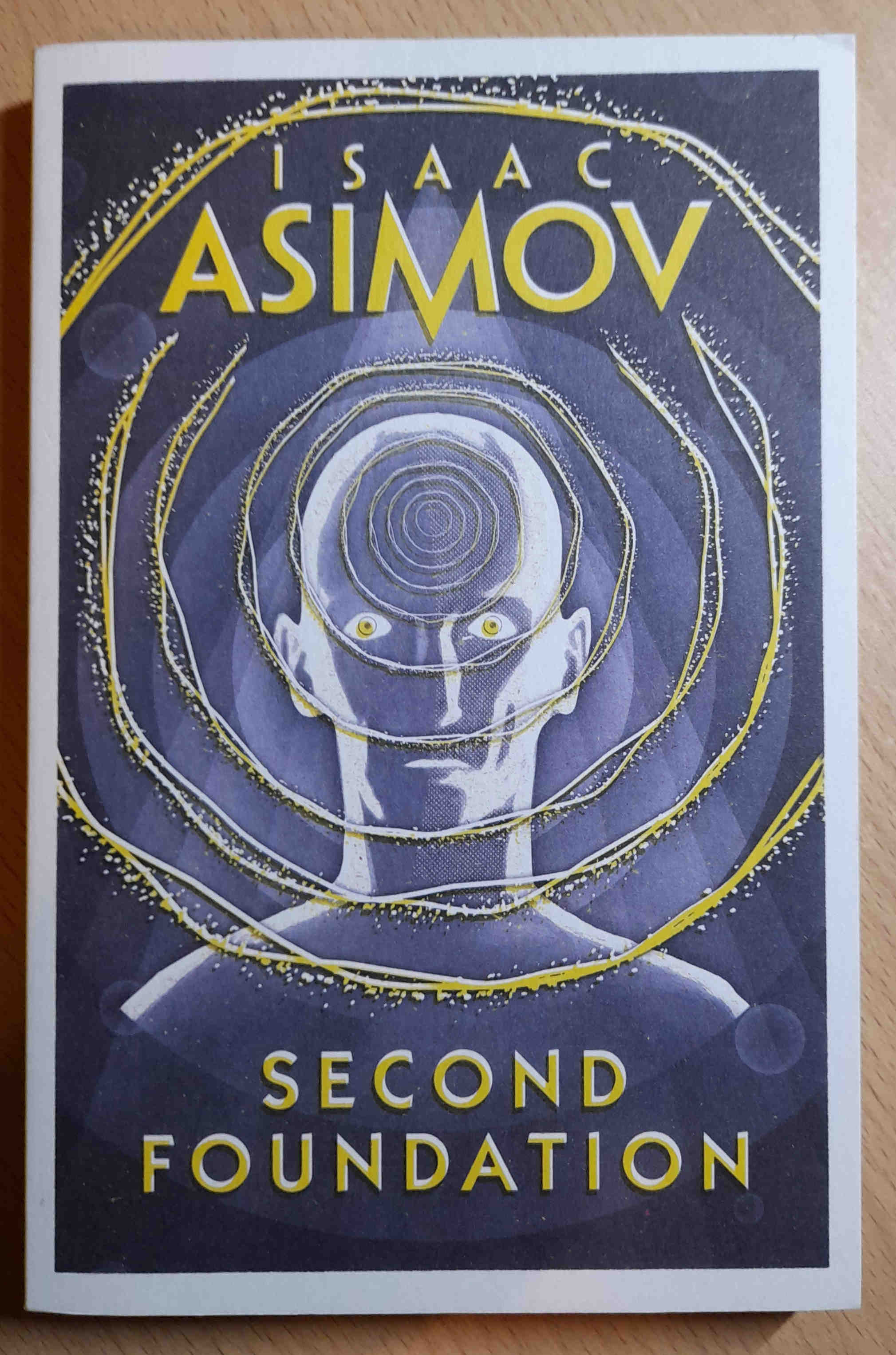
5. “Second Foundation” (1953)
‘Second Foundation’, the third book in Asimov’s original trilogy, explores themes of power, control, and free will, particularly the tensions between open political authority and hidden psychological influences. It questions whether the benevolent manipulation of populations can be justified if it serves a greater historical good, and if knowledge itself becomes dangerous when concentrated in the hands of a few. Asimov continues to contrast the use of brute force with intellectual and psychological power, raising questions about which form of control is ultimately more profound and more unsettling.
The Mule, a mutant conqueror who has disrupted Hari Seldon’s Plan, now controls most of the galaxy. His primary remaining concern is the rumoured existence of the Second Foundation, which Seldon established as a safeguard to correct deviations in the Plan. The Mule believes that if the Second Foundation exists, it poses the only serious threat to his rule, and he therefore sends agents across the galaxy to search for it.
Clues lead the Mule to suspect that the Second Foundation may be located on Trantor, the former imperial capital. He eventually travels there, convinced that confronting the Second Foundation directly will allow him to eliminate it. On Trantor, the Mule encounters a group of individuals who appear to have mental powers. Believing them to be members of the Second Foundation, he confronts and overcomes them. However, this group is later revealed to be a deliberate decoy. Unknown to the Mule at the time, the real Second Foundation, whose members possess advanced mental abilities, secretly intervenes and subtly alters his mind. As a result, the Mule loses his aggressive drive for conquest and abandons his galactic ambitions, dying shortly afterward without realising he has been manipulated.
The Mule’s empire quickly begins to collapse. Attention then shifts to the First Foundation, now led by a new generation, some of whom have become concerned that the Second Foundation’s mental powers represent a long-term threat to freedom. They fear that the Second Foundation may be guiding humanity along the Seldon Plan without consent, using covert mental control. A group is sent out to locate and neutralise the Second Foundation. Their search is based on clues from Seldon’s recordings, which suggest that the Second Foundation was established “at the other end of the galaxy” from the First Foundation. They initially interpret this phrase in a literal, geographical sense.
In the final section of the book, it is revealed that the Second Foundation has always been located on Trantor, not at a distant edge of the galaxy. Its members are mental scientists, carefully trained to preserve Seldon’s Plan through minimal and precise interventions. The First Speaker of the Second Foundation allows the First Foundation’s leaders to believe they have successfully neutralised the threat. In reality, the Second Foundation subtly alters their memories and perceptions, ensuring its continued secrecy and preserving the balance envisioned by Hari Seldon.
– fair use for non-commercial review
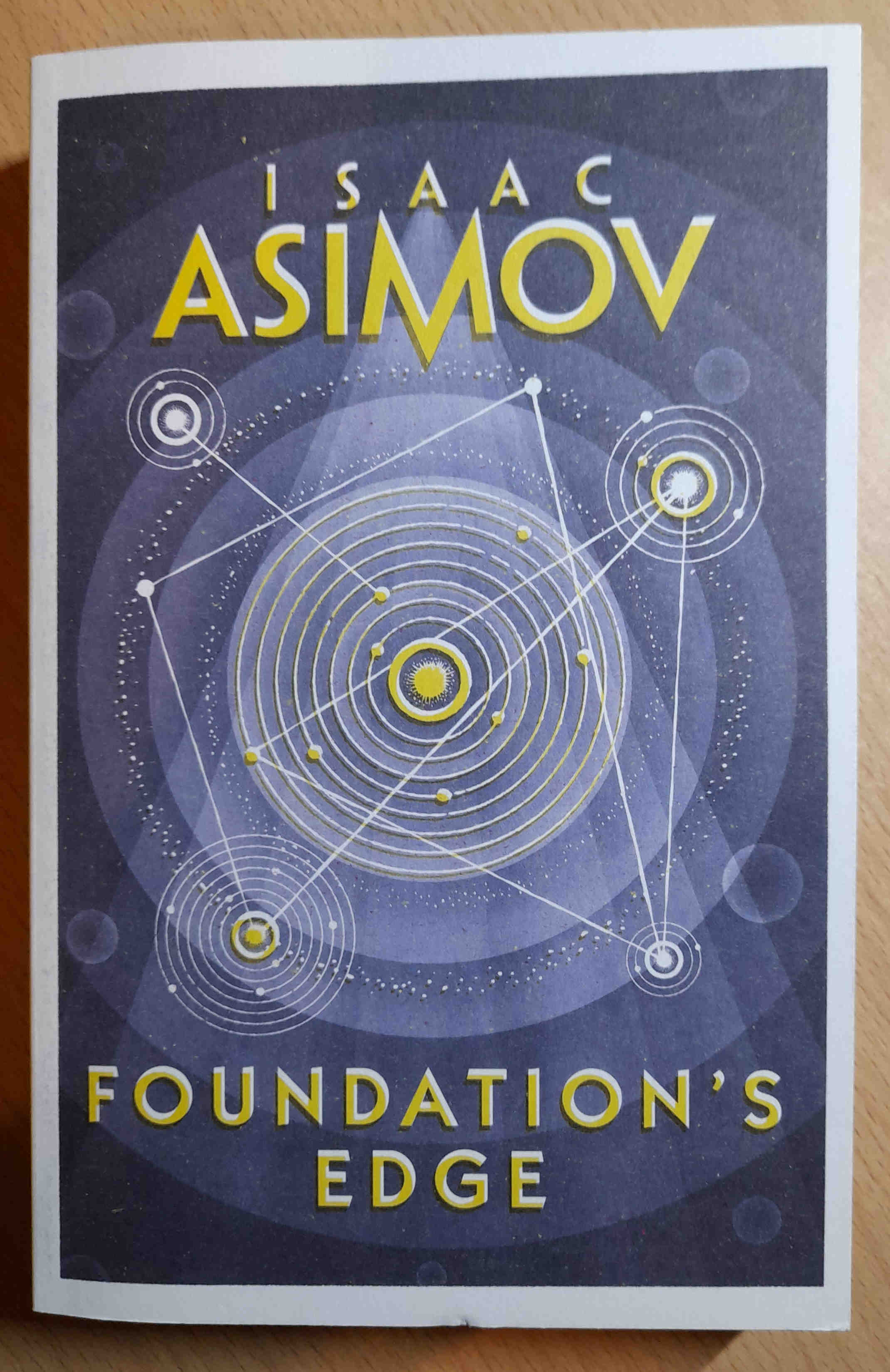
6. “Foundation’s Edge” (1982)
The penultimate book in Asmov’s series, ‘Foundation’s Edge’ explores the limits of prediction, the ethics of control, and the tension between individual freedom and collective stability. Asimov questions whether history should be guided by mathematical inevitability, elite manipulation, or shared consciousness. The novel also introduces doubt into the certainty of psychohistory, emphasizing intuition, moral responsibility, and the possibility that survival may require fundamentally rethinking what it means for humanity to exist as a civilisation.
The novel opens roughly five centuries after the founding of the First Foundation. The Foundation has grown powerful and confident, and many believe Hari Seldon’s psychohistorical Plan is essentially complete. This confidence is challenged when Golan Trevize, a member of the Foundation Council known for his independent thinking, publicly questions whether the Plan is still on track. Trevize suggests that there may be a hidden influence shaping history beyond what Seldon predicted. He senses that something fundamental is wrong, that humanity’s destiny may still be constrained.
Rather than silencing Trevize, the Foundation’s leadership exiles him in a subtle way by assigning him to investigate the rumoured Second Foundation, which supposedly manipulates minds to keep the Plan on course. Trevize is given a ship and paired with Janov Pelorat, a historian obsessed with myths and legends, particularly the story of Earth, humanity’s forgotten original home.
Trevize and Pelorat travel through several worlds following clues that suggest the Second Foundation may not be where earlier histories placed it. Along the way, Pelorat’s research into Earth becomes increasingly significant. The pair encounter Stor Gendibal, a young and highly capable speaker of the Second Foundation, who reveals that the Second Foundation is itself under threat. Gendibal explains that the Second Foundation has detected a dangerous, hidden mental power greater than their own. She brings Trevize and Pelorat to Trantor, the Second Foundation’s secret base. There, internal conflict unfolds as Gendibal faces opposition from older members of the Second Foundation while trying to expose this unknown force.
The mysterious power is eventually revealed to be Gaia, a planet where all living and nonliving matter shares a single group consciousness. Gaia has quietly influenced galactic events for centuries. Unlike the Second Foundation, which manipulates individuals, Gaia works through collective harmony and long-term balance. Gaia proposes a future transformation of the galaxy into ‘Galaxia’, a single unified super-organism similar to Gaia itself. This would replace both the Seldon Plan and the Second Foundation’s stewardship. Crucially, Gaia asks Trevize, not a psychohistorian or mentalic, to decide whether this future should be pursued.
After intense reflection, Trevize chooses Galaxia. He reasons that a galaxy-wide consciousness would be better able to respond to unforeseen external threats than either a rigid psychohistorical plan or elite mental control by the Second Foundation. The novel ends with Trevize deeply uneasy, aware that although he believes the decision is correct, he cannot fully articulate why.
For me, the progress of ‘Foundation’s Edge’ was somewhat slow and plodding, feeling much less aligned with the earlier themes of the series. Asimov is laying out the groundwork towards the final book in his series, but I wonder if that could have been achieved in a more satisfying manner within a shorter manuscript.
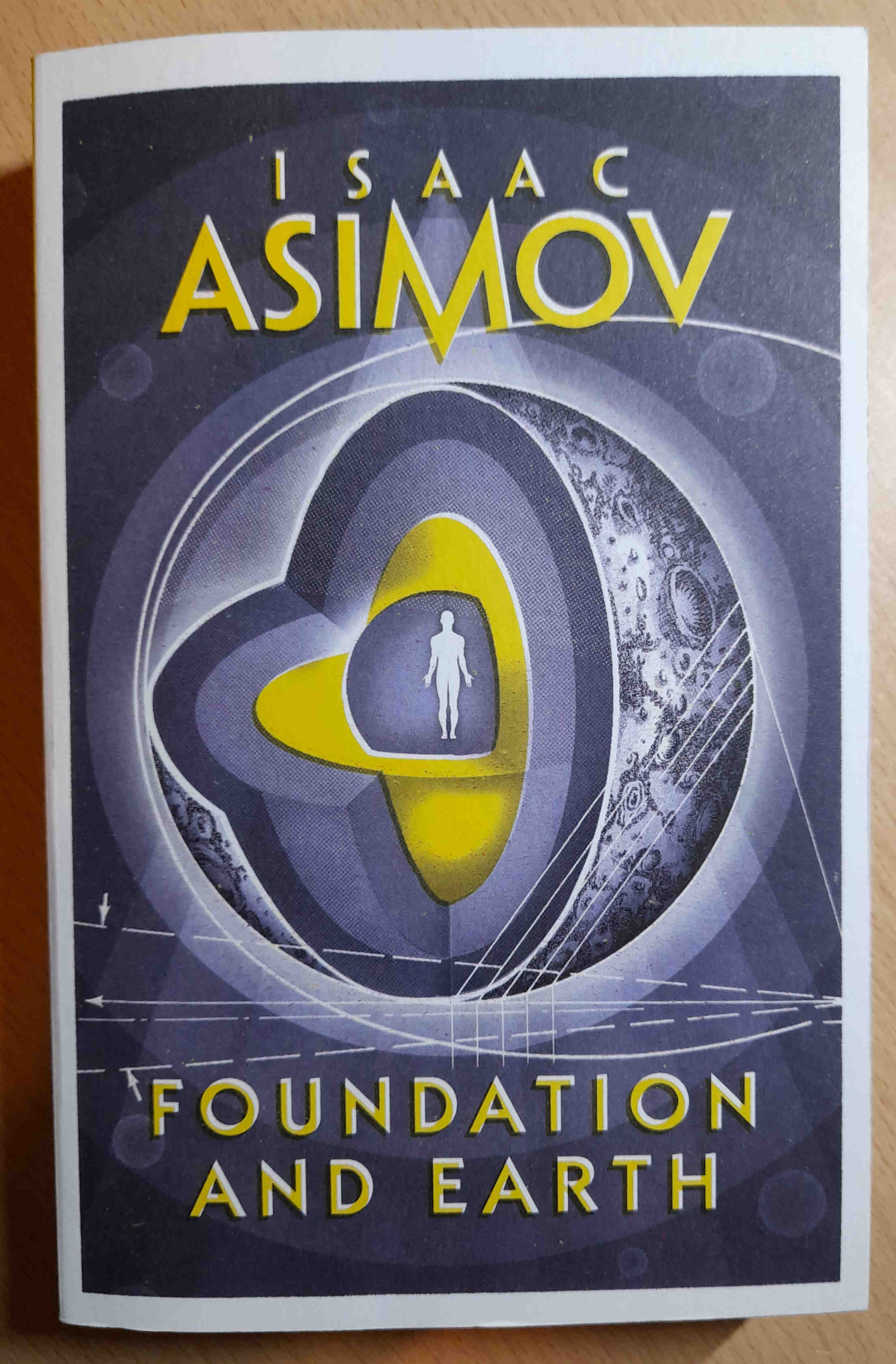
– fair use for non-commercial review
7. “Foundation and Earth” (1986)
We have now reached Asimov’s final words (in the order of the series) on The Foundation.
‘Foundation and Earth’ explores themes of historical memory, free will, and social responsibility on a civilisational scale. Asimov examines how societies forget their origins, how power can operate invisibly over vast spans of time, and whether benevolent control can ever be justified. The search for Earth becomes a search for meaning and moral certainty, culminating in the uneasy conclusion that humanity’s future must be chosen to be a part of Gaia / Galaxia, not because it is perfect, but because it may be the least destructive option available.
At the start of the book, Golan Trevize, Janov Pelorat, and Bliss (a sentient manifestation of Gaia) leave Gaia to search for the long-lost planet Earth. Trevize is troubled by his earlier decision to support Gaia as the future of the Galaxy, and he believes that understanding humanity’s true origins on Earth may either confirm or undermine that choice. Pelorat, a scholar of ancient myths, is motivated by historical curiosity, while Bliss serves as Gaia’s representative.
Their journey takes them to several worlds that preserve fragments of humanity’s distant past. They uncover partial records, legends, and technological clues suggesting that Earth was humanity’s original home, but that it vanished so completely from history that later generations came to doubt it ever existed. Each discovery reinforces the idea that knowledge of Earth has been deliberately or accidentally erased over many millennia.
On the planet Aurora, once one of the oldest and most influential Spacer worlds, they encounter remnants of advanced robotic technology. They learn that Aurora and other Spacer societies declined long before the rise of the Galactic Empire, and establish a deep historical link between robots and the early expansion of humanity away from Earth.
They also visit Solaria, a planet whose inhabitants have evolved into extremely isolated and biologically unusual humans with advanced mental abilities. The Solarians are hostile to outsiders, and the group narrowly escapes danger. This episode demonstrates one extreme path of human development and highlights the long-term consequences of technological and social isolation.
They eventually locate Earth itself, finding it to be abandoned, lifeless, and dangerously radioactive, incapable of supporting human life. The condition of the planet confirms that Earth truly was humanity’s origin but also that it suffered a catastrophe long ago, explaining why it disappeared from common knowledge and legend.
Further exploration leads them to the Moon, where Trevize encounters R. Daneel Olivaw, an ancient robot who has survived since the era of Earth and the early Spacer civilizations. Olivaw reveals that he and other robots have subtly guided human history for tens of thousands of years, acting according to an expanded interpretation of the Three Laws of Robotics that prioritises the welfare of humanity as a whole. Gaia represents the culmination of this long guidance, offering a future in which humanity forms a single, cooperative galactic consciousness. Trevize realizes that his earlier choice in favor of Gaia was influenced by this deep historical momentum. Accepting the truth about Earth, robots, and humanity’s past, he reluctantly reaffirms his decision, recognising that no alternative path is free of risk.
Some Final Thoughts…
Collectively, the seven books of the Foundation series chart humanity’s attempt to survive the collapse of a galaxy-spanning civilisation through knowledge, planning, and ethical restraint. What begins as a mathematical solution to historical decay evolves into a meditation on power, freedom, and responsibility. Central themes include the limits of prediction, the danger of centralised authority, and the role of exceptional individuals in shaping history. Asimov gradually shifts from a faith in rational planning toward a more nuanced view that embraces uncertainty, moral judgement, and adaptability.
As a whole, the series tells a distinct story of civilisational development. Its relevance today lies in its exploration of systemic collapse, data-driven governance, and ethical foresight… issues that resonate in this age of Big Data, AI, and global instability. It is quite different from Gibbon’s “The History of the Decline and Fall of the Roman Empire”, which was the early seed of Asimov’s inspiration for Foundation. It ends not with finality, but with open-ended responsibility, emphasising that the future must always be chosen, not merely predicted.
The Foundation series has received extraordinary recognition. In 1966, it won the Hugo Award for Best All-Time Series, surpassing even The Lord of the Rings. Individual volumes have been praised for their intellectual ambition, and the series has influenced generations of scientists, economists, and SF writers. It is broad, deep, and imaginative, surpassing the superficial characteristics of much early Golden Age SF, retaining a unique sense of theme and events that have ensured its top-tier place as a piece of Grand Master fiction.
 Lee J. Russell, Author
You must be logged in to post a comment.