First published in the United States by Ballantine Books in 1970, Ringworld by Larry Niven is often listed as one of the “must read” SF books. It won the 1970 Nebula Award, as well as both Hugo and Locus awards in 1971.
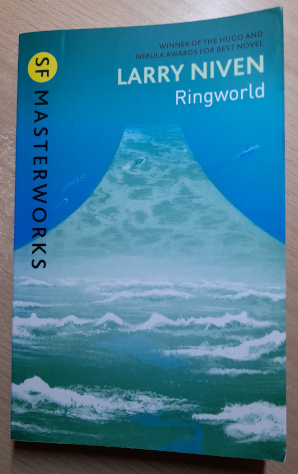
The book immediately captured the imagination of readers and critics alike because of its innovative central concept of a habitable ring having been created around a star. The story combined the grandeur of a space opera with the logical underpinning of so-called “hard science fiction”, in an era when space exploration and cosmic speculation were gaining cultural traction. Its ideas of mega-structures, mega-engineering, morality and civilisation inspired many subsequent works.
The story opens with Louis Gridley Wu’s birthday celebrations, He is a 200-year-old human adventurer, kept youthful by a longevity drug called ‘boosterspice’. Louis has become bored with life and accepts a strange mission from Nessus, a ‘Pierson’s Puppeteer’ (a kind of highly cautious, three-legged alien). Nessus also recruits two other companions: Speaker-to-Animals, a ‘Kzin’ warrior (the Kzinti being a fierce, feline species), and Teela Brown, a young human woman whose “luck” seems almost supernatural. Upon completing their mission, which Nessus does not explain in any detail, their reward will be a much faster starship than anything humans or the Kzinti currently possess.
After travelling to the Puppeteer’s homeworld, they discover that their real destination is the enormous “Ringworld”, an artificial ring of stellar proportions orbiting a sunlike star. The Ringworld is a gigantic rotating mega-structure whose inner surface offers a breathable atmosphere, simulated gravity via rotation, huge landscapes, and vast oceans.
Upon approaching Ringworld, their ship (the ‘Lying Bastard’) is disabled by an automated defense system and collides with a near-invisible ‘shadow-square’ wire, causing them to crash-land. Stranded, they set out on ‘flycycles’, traversing the vast surface towards the rim, hoping to find technology that will help them to repair the Liar and escape. Along the way, they encounter primitive humanoid societies who revere them as godlike creators (‘Engineers’). They also learn that the Puppeteers have manipulated both Human and Kzinti genetics for their own ends, including breeding “lucky” humans like Teela.
In a daring plan, Louis threads a ‘shadow-square’ wire from their crashed ship to a floating station, climbs up to a hole punched through the ring (the “Fist-of-God”), and uses the station’s momentum to launch their ship back into space. Teela, having found love with a Ringworld native, chooses to remain.
The Ringworld itself is a ‘big dumb object’, vast, enigmatic, and almost incomprehensible, evoking both wonder and existential curiosity in a manner that reminds us a bit of Arthur C. Clarke’s “Rama”. The Puppeteers’ breeding programs force us to consider free will, luck, and predestination. The collapse of civilisations highlights themes of technological fragility, entropy, and the rise-and-fall cycle of societies.
For its time, Ringworld is a masterful work of science fiction. However, fifty years later, it felt dated to me when compared to the broad expanses of setting and characterisation in stories by the likes of Iain M. Banks, Kim Stanley Robinson, James S. A. Corey and others. Niven’s characters felt curiously under-developed, whilst the overall pacing was episodic without any real twists or turns. It was interesting to get “Ringworld” off my to-be-read list (on the fourth attempt), but overall I am rather reluctant to recommend it as a ‘good read’.
 Lee J. Russell, Author
You must be logged in to post a comment.