In my opinion, the purpose of Physics is to determine the key physical processes governing how the natural world works, and to write down the associated mathematical Laws which describe them. From Galileo to Newton to Einstein, building on the work of thousands of scientists, much (obviously not all) of the focus has been on Mechanics, ie how objects interact with forces and move in Space/SpaceTime. These physical laws should cover both the classical world of macroscopic objects and the quantum mechanical world of sub-atomic particles.
A scientific revolution was kick-started in the early 20th century with the discoveries of Einstein’s Relativity theories and the development of Quantum mechanics. That revolution drove amazing developments in mathematics and the physical sciences, including the Standard Model of Particle Physics, LASER technologies and Cosmological theories, for example.
The development of new technologies based around these discoveries has been important for the growth of modern (especially industrialised) societies. However, I believe the most important work has been in the attempts to unify Relativity with Quantum Mechanics in order to describe how the force of gravity operates at the quantum level (ie ‘quantum gravity’), and the pursuit of a Grand Unified Theory (GUT) explaining how our universe operates at its most fundamental physical level. One might hope that in some cases a theory of Quantum Gravity could emerge from a GUT, or that developing a satisfactory theory of Quantum Gravity would lead to new mathematical formalisms that help in the discovery of a GUT.
Steady reading over the past twenty years, listening to podcasts and watching videos (like those from the World Science Festival), had led me to conclude that String Theory was most likely to lead to the discovery of a GUT.
I reached the point where I wanted to see the mathematics for myself… and that is when the trouble started.
Wherever I looked, I heard that String Theory was a well-developed Physics theory, widely supported in the academic community and taking us to exciting discoveries about the fundamental nature of the universe. And yet outside of the ‘string theory community’, nobody was saying to our general society EXACTLY what this theory is, how it is formulated and what it is predicting.
Then I learnt that there is not a single String Theory, but a whole extended family of incomplete principles and mathematical statements, perhaps 10^500 of them, most of which don’t map to our experience of the real world and which can’t be used to derive discrete solutions (as opposed to infinities) unless a whole new structure of ‘supersymmetric particles’ is invoked. The existence of supersymmetric particles was about the only ‘prediction’ of String Theory that could be experimentally tested in the Large Hadron Collider… and so far they have not been found to exist.
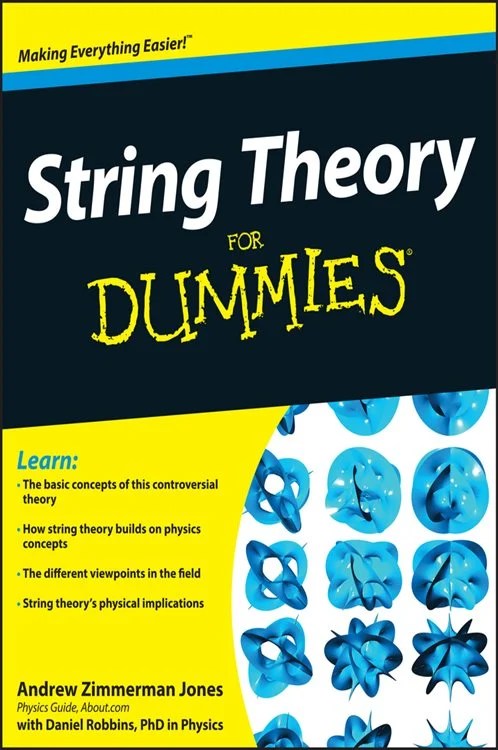
By accident I found a ‘String Theory for Dummies’ book, written by Andrew Zimmerman Jones and Daniel Robbins, and hoped this would at last answer my questions… but it didn’t. Jones’ most relevant claim for credibility as an author in this area is that he is the “Physics Guide at About.com” (whatever that means) and has a bachelor’s degree in Physics from Wabash College. You have to scour the pages for it, but Robbins has a PhD in Physics and studies String Theory at Texas A&M University. Looking on arXiv.org, I could see that Robbins has published some papers in relevant areas.
Overall I found their book to be a huge disappointment. Most of it is not about String Theory, but instead talks about other foundational topics in Physics. When the focus is on String Theory:
* we learn almost nothing about that actual theory / family of theories,
* we do not see any of the mathematics,
* we do not see predictions that could be tested experimentally.
We are essentially told to trust that it is a great theory, without seeing anything to convince us that the huge focus on studying it is a good investment of academia’s resources.
I could not believe that there is essentially nothing published that would explain to a capable, generally well-informed, non-academic audience, what String Theory actually is.

Then I read Lee Smolin’s 2006 book “The Trouble with Physics”, and the mists cleared for me.
Smolin is a theoretical physicist who worked for a time on String Theory, but was not persuaded to devote his career to it. He takes 355 pages to explain why String Theory is not delivering anything like a proper scientific theory, why discoveries in theoretical Physics have essentially stalled, and why the Fundamental Physics community needs to encourage a much broader range of possible approaches towards developing theories for Quantum Gravity and GUTs. I was amazed when he said in chapter 18 “… I can think of no mainstream string theorist who has proposed an original idea about the foundations of quantum theory or the nature of time…”
It seems to me that String Theory has become the ‘Emperor’s New Clothes’ of theoretical Physics, always claiming to be on the cusp of delivering amazing revelations about the nature of the universe, yet never getting there. I will take on trust that, within the String Theory community, the mathematics is quite beautiful… but by itself that is not enough.
I want to know why the universe is like it is… for real… not just a self-gratifying mathematical pipe-dream.
I no longer believe that String Theory will explain the true fundamental nature of our universe, matter, space and time. My focus has shifted to much less trumpeted areas like Loop Quantum Gravity and Roger Penrose’s Twistor Theory. It is now clear that a few people are investigating other approaches for GUTs and Quantum Gravity, despite the PR/media machine that has otherwise created an impression that String Theory is the only game in town. Instead of feeling disappointed by a lack of results in fundamental Physics, I’m feeling excited by all the other innovative ideas that are being pursued.
You can leave a comment on this post, or anything else on my website, with this form.
 Lee J. Russell, Author
You must be logged in to post a comment.